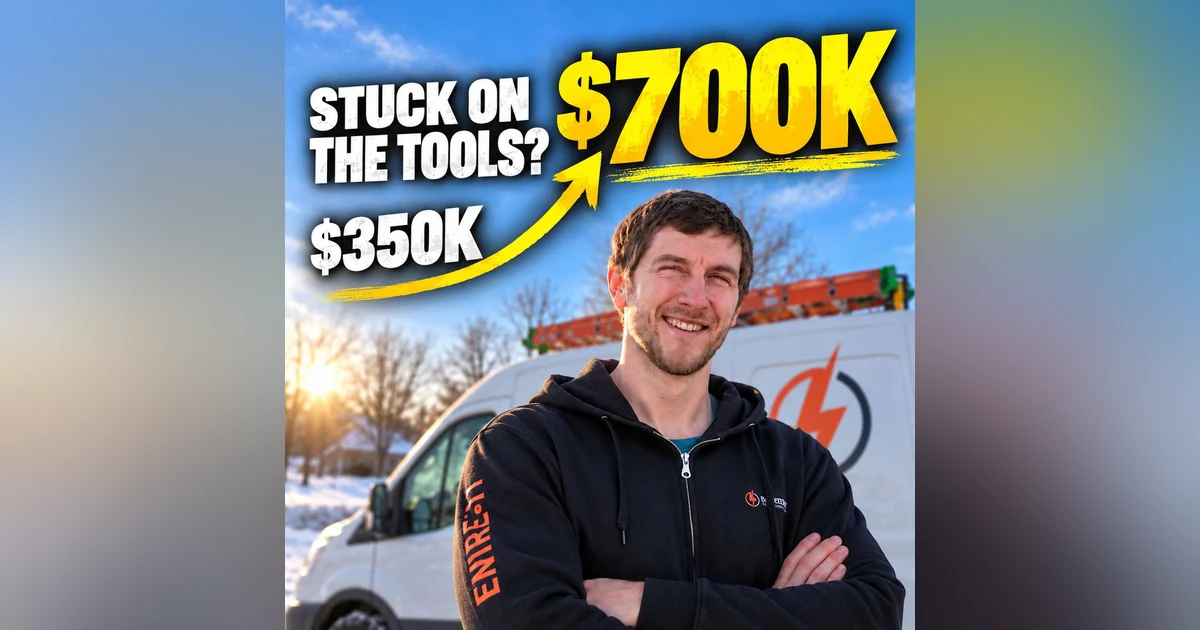
S3 EP50 How a Small Electrical Shop Doubled Revenue from $350K to $700K | Will Haggerty
Want the exact service-rate system Will used to more than double his average ticket? Grab the Service Rate Tool inside the SLE Pro App and steal the whole system: https://serviceloopelectrical.com/pro-app And if you want to see another small electrical shop turn the process into a breakout result: - https://youtu.be/g5dm8ry_izg ———————————— Most electrical business owners try to grow by running harder… Price from memory. Race through the service call. Email one number. Keep every in...


Want the exact service-rate system Will used to more than double his average ticket?
Grab the Service Rate Tool inside the SLE Pro App and steal the whole system:
https://serviceloopelectrical.com/pro-app
And if you want to see another small electrical shop turn the process into a breakout result:
- https://youtu.be/g5dm8ry_izg
————————————
Most electrical business owners try to grow by running harder…
Price from memory.
Race through the service call.
Email one number.
Keep every install clenched in a death grip.
Repeat until one dead van eats the entire year's profit for breakfast.
Meanwhile…
We've coached electrician after electrician through this exact transition.
And the shops that break through follow the same structure.
Like a Rocky training montage.
Same fundamentals.
Different shop.
Because great growth doesn't feel like sprinting between five emergencies…
It feels like finally running the business on purpose.
But behind the scenes?
The best growth is built more like a well-labeled service panel.
In this video, I break down the clarity → control → cash flow system that helps electrical businesses:
- price every job from real operating costs instead of gut feel
- raise average ticket by slowing down and presenting complete options
- protect cash flow with firm deposits before work hits the calendar
- delegate installs without sacrificing workmanship or customer trust
- build the capacity to grow revenue without living on the tools
Inside, I'll show you:
- the three-part operating framework behind Will's turnaround (clarity → control → cash flow)
- how one blown Ford Transit exposed the weakness in his entire pricing model
- why charging what you think you're worth is the wrong way to price service
- how slowing down helped move Will's average ticket from $1,100 to roughly $2,500
- why emailing a price objection back is usually broken
- how the “yes, and” method gets you closer to the real objection
- why silence at the kitchen table works like a pressure cooker—without pressuring the homeowner
- how to release your “baby bird” of installation quality without becoming a backseat driver
- how clear options helped turn Will's largest residential offer into his largest sale
Also…
There's a six-foot-seven Canadian introduction delivered like Bruce Buffer.
A “Tank Top Terry” roaming Nova Scotia in February.
An $18,000 engine failure directly in front of the fire department.
Eight weeks running the company from an in-law's truck and a cargo trailer.
And Christmas lights buried under mulch beneath an upside-down coffee can.
If you're new here, binge the channel.
If you own an electrical service business, steal the framework.
If you want to scale to $1M+ with less chaos…
Watch the Million Dollar Plan below.
————————————
And if you want to see our Million Dollar Plan — how we help Electric Service Business Owners build $1M+ companies without becoming a slave to the truck, the phone, or the chaos…
Watch here:
- https://youtu.be/T8wHmb56FwE
————————————
Podcast Scholarship Draw
Turn your support into real rewards.
Subscribe, leave a review, or follow us. each action = 1 entry.
Monthly: Open Circuit Lifetime Membership ($1,500 value)
Twice per year: Service Loop Electrical Packages ($5,000 value)
Submit your entry here!
https://go.serviceloopelectrical.com/mde-draw
How do you go from selling 350 to selling 700k in a single year? I started out because I didn't know what the heck to charge. It's not like I had a I was still running a personal vehicle for the first couple weeks until I could find something to use. You know, going from $50 an hour to we're in upwards of $400 or $500 now. It's just a mind shift. You have to go from this is what I think I'm worth to this is what I'm offering.
SPEAKER_02Hello, hello, hello, and welcome to the Million Dollar Electrician Podcast, where we help home service pros like you supercharge your business and spark up those sales.
SPEAKER_05I'm Joseph Witchani, and today's my co-host Clay New Meyer. We're here to share the secret that helps electricians sell over a million dollars in a single service desk.
SPEAKER_01Now it's time for sales. It's time for sale. It's time to become a million-dollar electrician.
SPEAKER_02Hello, hello, hello. Welcome back to another great episode of The Million Dollar Electrician. With me, as always, my esteemed co-host and uh half AI, half human, Joseph, the sales bot Lucani. Uh, we have Will here, also, another Canadian. Joe's outnumbered today. This is the Canadian special. Will Haggerty. Will's been with us uh a little while now. What uh a year, Will?
SPEAKER_00I think we're getting in close to two years.
SPEAKER_02Wow. Man, time flies and we're having fun. Will's got some great stuff to share with you guys today. We're gonna deep dive just like we have been with these great client interviews. Will is doubling up in every metric that we've got here prepared for you guys. Uh last year, Will looks like you finished around 350. But just moments ago, back scene, you told me that you're told us that you're on track to hitting 700 this year, doubling revenue. Is that right?
SPEAKER_00Yes, that's spot on.
SPEAKER_02Average ticket went from 1100, $1,100, which is actually really good for service, uh, considering, but you're um averaging about $2,500 currently. Is that right?
SPEAKER_00Yep, yeah. We're uh we're floating right around $2,500, give or take.
SPEAKER_02Yes, and a team size that went from two to four, so doubled the team as well, with a little part-time bookkeeping in there, guys. If you want to hear how Will's been doing this, and if you've been listening, you probably have some ideas already. Uh, but there's going to be a new take on it because Will's got a different perspective than anyone else we've had on the show. At six foot seven, how many pounds? We might as well announce this like Bruce Buffer.
SPEAKER_00Uh, we're floating around 215 or so.
SPEAKER_02Whew, six foot seven, two hundred and fifteen pounds. Will Haggerty. Welcome to the show, brother. Thanks for joining. It's gonna be a fun one. Joe, how are you doing today?
SPEAKER_05A lot worse than knowing that we weigh the same amount. Like I said, short and stocky, I guess. But anyway, um other than that, I'm feeling great. I think this is gonna be a great session together. I personally love working with him in class, love when it comes to options class, brings the whole team with him. So honestly, I think we're gonna have a great time together.
SPEAKER_02Well, here's the thing, Joe. I get that you told us what your weight is, but you did avoid saying your height.
SPEAKER_05That's true. I am 5'11, 215 pounds.
SPEAKER_02Out of boys. That's actually above average. Not the weight, the height 5'10. 5'10 is average uh male, isn't it? North America. I I think in the United States it's actually down to 5'8. As crazy as it is. That might be average, but what's not average is Will's growth year over year. Will, what changed last year versus this year?
SPEAKER_00If you had to sum this up, really adopting the process fully. That was kind of the uh the turning point when I hired my lead installer last year, about halfway. When I was had the job out out, and we had our meeting after that. It's like, okay, I really need to focus down and get this down pat that way. I can do more to bring him into the mix as well as better serve my clientele.
SPEAKER_02So little delegation.
SPEAKER_00Yeah.
SPEAKER_02I Joe, I'm not sure we spend enough time in this. I'm gonna ask a question that's not even on my my notes over here. Sure. Random, but so important. How hard was it for you to release the installs completely? Oh, as far as like let the team do it and not have to be like monitoring them. Yeah, Will, can you talk a bit about that? Like, what's that transition like for you to trust someone else with your customers? I just I always picture like there's this little baby bird in your hands, right? Like, that must have been hard for you. Can you walk us through that a bit?
SPEAKER_00Well, it was a transition because when you're used to being in charge of your own quality, you do it your way, and you know how you do it is the best possible way to install it. And uh being able to share that with someone else, it's not always an easy thing to do. And so he's when we hired him on, we had a couple, you know, sit-down, talk about methods and how we approach things, and even prior to some jobs, it was this is how I envisioned it going. Uh, you know, if you see a better option, please do tell me. Like I put that out there right away was if you think there's a better way, bring it up, let's talk about it. But fortunately, I also have an apprentice who's been working with me for two years or so now. He knows what I expect as well. And he was able to kind of watch over the guy and go, hey, we don't do it that way because of X reason. So that was a really good ball to have in my court too, because I could send them out together and they'd be able to get through 90% of it without issues. I love and it was always that little, oh, how would you approach this? How would you do that? We did this, what were you thinking? And a lot of those questions now have really calmed down because he's in a groove, he knows what's expected, he does excellent work, and uh that's really taking a load off my plate.
SPEAKER_05Yeah, I love that for you. I almost want to know if there's like a second question that follows that because originally it's was it hard delegating install? Now I love that you have a guy who can now step to the plate and do that thing. What are your thoughts as far as letting them do the service themselves? And let me give you an example of what I mean by that. Like, there's always a better electrician, right? I can all of us are good electricians, but there's always a better one that's out there. But it's hard to find someone who's better at service once you've gotten dialed into knowing what it's included and what it's like. Like, what would you what have you done so far to help them do a job in a way that you know that you're gonna have the customer treated the same way?
SPEAKER_00That came down to a lot of I think personality traits that I was looking for. If the fella, you know, when I was interviewing them, if they had kind of a a calm demeanor not walking in with a chip on their shoulder, just very down-to-earth, I found that comforting. And so that's what I was looking for. So being able to hand off the customer interactions to them, they've gotten great reviews from any of the clients they've worked for. They say they're they clean up, they're well mannered, they joke back and forth with us and each other, and you know, kind of treat each other well. It was still like there's still some service calls that I'll say, okay, we'll book in the other crew for that. And every now and then I'm in the back of my head, it's okay. Well, did they do a mega test on the cable? Did they do a current check on the the circuit that was tripping? Did they do all these little things? And it's like, no, no, they gotta kind of sort this way themselves, but I can at least review after or even before saying, you know, this is what I expect. And then after the job, it's okay. So what did you do? What did you see? What did you test? I love that.
SPEAKER_05That's a great approach compared to backseat driving your techs because they'll that's a one-way ticket, then resenting you forever while also learning nothing.
SPEAKER_02Yep. Yeah, it's super important. That's why I caught my ear right away. So interesting, and yet we don't talk about it enough, but it's one of the most asked questions in the group. It's like, A, where do I find an installer? There's no electricians out there. B, how do I find someone worthy of taking this? And then C, how do I give this to them without oversight? Uh and I think that's there's a mistake in the question, even obviously, oversight needed to be there. Did you follow a bit of kind of uh okay? I check in, I do this with you. Was there a process of you letting go from that installer, Will?
SPEAKER_00So the way it started out was he would do the install. So I would still take on the service calls, any troubleshooting calls, I'd still take myself, put it on my plate. But for installs, you know, it started out oh, we're gonna be working on a service upgrade this week. And in our province in Nova Scotia, we have minimum standards we have to meet. We can't just change the meter, change the panel, walk away. There's a bunch of little things we have to do. And this particular client, they had also requested a full uh electric baseboard swap in. So it was a really good experience to see how he handled it, as well as okay, you did it this way here. Next time I'd like to see small improvements, you know, clean things up in the wiring we do, because you ran it this way over here. We should be running up in the joist or put strapping in, little things like that. So that first job with him was a really great learning experience for me as well. Uh, because then I could see how he worked versus how he said he worked, as well as what kind of quality he was going to be putting out versus what I would expect. And we could immediately look at it and say, This is what you did, this is what I expected, here's where we can do some small changes, here's where you really did well. So it worked out really well that first job, and from there it just got the ball rolling.
SPEAKER_05I love how you said the difference between what he knows versus what he says he knows. Has that been a situation that's that's obviously a symptom a lot of us have dealt with? What's the craziest situation you've run into where Tech said he could do something and then didn't know?
SPEAKER_00It's not necessarily where someone claimed to know something, but it was something that had happened to an apprentice I worked with at another company. Laid on me. They were given the task of running some conduit down a wall. And you know, I think I ended up being in charge that day because the other foreman was off-site. And so I was walking by just checking on everybody, and I kind of see him struggling a little bit. And I just say, Hey, do you need a hand? He says, Yeah, I can't get this pipe over top of these other pipes. And I said, Well, did someone or did anyone kind of slow down and say, This is how you accomplish this task? He said, No. I said, Okay, well, let's let's go through it together. And we went through it together, and uh, you know, the next day he came up to me and said, You know, thank you for doing that. That's that's what I needed. And so I don't know if it's you know my past upbringing or just how I approach things, but I always figure that it's better to try and be a mentor and be a teacher than to be uh a crotchety guy in the corner. No one likes the old foreman, right?
SPEAKER_05Be someone who appreciates new help, yeah.
SPEAKER_02Will you got that calm demeanor about you? I'm trying to I'm trying to think through what your leadership style is, and I think what you just said really helped me with that. Do you ever get mad on the job? Like, does your heart rate spike? Does your voice raise? Do do you get is there another personality that comes forward? Or is this calm will all the time, just like this? Cool as a cucumber.
SPEAKER_00Well, I mean, there's always times where you kind of bite your tongue and utter a few curse words under your breath, but for the most part, I mean, if an issue comes up on a job, you just get a step back and say, What do I do now? And you just take a moment, take a deep breath, and you just keep pushing through. That's just how I approach it.
SPEAKER_05Yeah, you're a better man than most, I'll tell you that.
SPEAKER_02Not all of us have that same cherub-like demeanor. Yeah, anger management should probably be part of the uh journeyman process. Uh not in Canada, we're we're nice people, but down there, Joe, where you are, man, you whew, you got a temper, right? Just flares up. I was I hope you're picking up my satire. I'm just kidding.
SPEAKER_05Yeah, I was gonna say, I was like, I was told like I've learned your particular brand of humor, but you're actually not wrong to an extent. Because when I was doing my my lineman training, they literally said you wear the hard hat not to fall, you wear the hard hat that dods the tools that are thrown at you from up above. So, yeah, that's a big thing that happens.
SPEAKER_00Something else that comes up too is uh something I'd heard was plan the work, work the plan. So if you can plan it well enough, you know, little glitches that come up, they're they're easy to get over. That works.
SPEAKER_05You can give you on that.
SPEAKER_02I uh I was watching a quick comedy skit with my daughters last night, and I can't remember the name of the comedian, I've seen him before. Hilarious guy, but he was just bashing on Canadians, doing a Canadian uh stand-up skit, and and he said, you know, Americans, we get the label of like arrogant. You know, we're that team, but can't Canadians, you guys are polite. And just now, as I say that, I heard a bunch of Canadians go, we're not polite, it's passive aggressive. And he goes, Yeah, two Americans, that's polite. You're right. It was hilarious.
SPEAKER_05You're not wrong there, man. Well, granted, this the standard's pretty low down here for what what considers nice, so I'll take Canadian, uh Canadian people any day.
SPEAKER_02You know, I don't even see a line. I mean, between you and I working on this, I just see electricians and every other trade being beneath us. Maybe that's harsh, but I mean cater to our audience, right? Yeah, you know what?
SPEAKER_05Like, despite having the HVAC license, I never want to go up in an attic for anything to do any kind of air handler work. Just give me my wires to play with. I picked my trade, and that's that. As long as you can work with everybody, that's important too. That's important too. Finding a way to not end up killing everyone around you, is also a big American factor we have to deal with too, right? For lack of better words.
SPEAKER_02Will, could you remind me what's Nova Scotia's journeyman process? The apprenticeship? Is it four years for you guys too?
SPEAKER_00Yeah, so Nova Scotia, like most of Canada, it's uh a red seal program. So you have to find someone to get indentured, and then you have your four apprenticeship blocks, and you have to get 8,000 hours logged in that time. So for me, that ended up being about four years.
SPEAKER_02Yeah, we got a real electrician here. How many uh weeks of school did you have to do each year?
SPEAKER_00It was roughly about seven or eight, depending on which block you were into.
SPEAKER_02Nice, very cool, very cool.
SPEAKER_00Now, the one thing that Nova Scotia doesn't have is they don't have a master's program like what Ontario, Alberta, and BC would have.
SPEAKER_02Really?
SPEAKER_00Yeah.
SPEAKER_02I I stamp of approval will you get a master's certificate from us. You're there, brother. Um, so you don't need an additional license to pull permits.
SPEAKER_00Nope.
SPEAKER_02Interesting. So that probably lowers the lowers the standards bars a bit.
SPEAKER_00It can, I think. It can. I've heard from some inspectors that there's people they know to look out for. And I'm sure that's public knowledge to some degree as well. They know that if X is doing a job, they have to check A through Z. They know if someone else is doing a job, they can relax a little on A and be a little more stringent on a later half.
SPEAKER_05Oh, hopefully you're at the level right now where he's like he rolls up to the job site, lowers his window, hands you the approval sticker, rolls it back up, and backs out. Some jobs a little closer than others.
SPEAKER_02So, well, just thinking about what this means in your market, technically, any electrician is your competition.
SPEAKER_00Yeah.
SPEAKER_02Wow. Yeah. Okay. This is interesting. So let's go back from installs to leads here for a minute. Then, do you see that happening a lot? Is every electrician innately leaving school and applying for a job and banging on doors trying to get work themselves at the same time?
SPEAKER_00You do see it a lot with uh apprentices later on through the program. They'll start doing side work and that'll just build up over time. So when they get the red seal, they pop a shingle out at the end of the driveway. I didn't follow that. What do you mean?
SPEAKER_05I was gonna say, well, is that a Canadian reference? I was looking at you, Clay.
SPEAKER_00What's pop a shingle mean? I guess it's something I've heard here. It's uh when I first started my business, a lot of people were saying, Oh, congratulations on hanging a shingle. So I guess it's a bit of a colloquialism or an analogy, however you want to put it, you know, putting out a sign or hanging a shingle or equivalent speech. Ah okay.
SPEAKER_02Went over my head too, Joe.
SPEAKER_05I've I've learned to gauge the room, and if I don't get something, I look at the two smartest people here and I'm like, all right, let's see what they're thinking.
SPEAKER_02Yeah, yeah, that's interesting. Okay, yeah. So competition higher prices lower, I would bet, then.
SPEAKER_00Yeah, it will drive pricing down. I heard secondhand from uh recent uh meeting with our authority having jurisdiction that the province wants to keep barrier to entrepreneurship low, which is great. You know, it's great that that enables people to start a business to run themselves, but it can also bring up some issues. You know, you hear quite a bit of tank top Terry down the road, just declared bankruptcies, suppliers don't want to deal with them anymore. I thought it was too cold for tank tops up by you. You'd be surprised. There's lots of kids running around in t-shirts and shorts in the middle of February.
SPEAKER_05Well, that's because you condition them with being so cold, they're like, Oh, it's it's only above freezing. This is perfect. What are you talking about? Rick got the warm weather.
SPEAKER_00Yeah, yeah, that's interesting. So you're are you getting many price objections then? Oh, we we certainly get our fair share, but I've had plenty of people say, uh, well, I'll use one example. We had uh client who wanted us to put some electric heat in her office. We were easily double what the other fellow was charging, but you know, because we slow it down, we go through it with the client, she says, You provide the information way better, you lay it out way better. I want you to do the work, even though you're twice the price.
SPEAKER_02Yeah, okay, that's interesting. I was gonna say with that, but maybe you answered already. Do you feel you're the most elect uh most expensive electrician in your area?
SPEAKER_00I feel that I am. I have an apprentice again, he's got a lot of business experience. He kind of did his own landscaping thing, sold that off. He's looking at some of the pricing we're doing now, and he says you're on the right track. I don't know where he gets that from, but uh, I do feel that we are one of the more premium priced options in the area, but we try to provide that premium experience.
SPEAKER_05All I was gonna say in this moment is I feel like perspective is the difference between us getting defeated by price objections and not. And like, let me explain what I mean by that. So you feel you're the most expensive, your apprentice doesn't have that same view. Now, my view on expensive is where you're at in percentage of everything else. Like when I first started, I was working with a company in 11 that was charging over 600 an hour. That's expensive with compared to today's rate, that's like 800 bucks an hour. That's insane. But you operating at two, three, four, five hundred, that's actually below a lot of people now. Like you wouldn't think, but like the country and continent as a whole, our whole hourly rate has gone up so substantially that you may be more than what your reference point is, but your reference point is currently outdated. Yeah, does that make sense? Yeah, yeah, that that totally makes sense. Yeah, like you making a hundred thousand dollars in the nineties is not you making a hundred thousand dollars in 2026. Perspective and reference changes, yeah.
SPEAKER_00And uh so again, just referring back to that meeting that our authority having jurisdiction had, I was talking to a couple of people there about this program. They said, Oh, yeah, we've seen that. And then I like I had a half-hour conversation with one of them. They were asking kind of specific questions, and you know, how did you come up with the pricing? What does that program involve? This sort of thing. I just kind of explained to them, well, they set out the simple service rate, we base it on that, make sure we deliver options for our customers, sit down, you know, bring coffee to them if we have to, that sort of thing. You know, it's just a matter of slowing down and going through things, being prepared to you know stick to your price or stick to your offer, as you say. And uh, you know, they were pretty pretty happy to hear that, I think. And then even again, the one of the local guys down here who talking about you know, trying to replace his vehicle, doing this, doing that. He was asking, Oh, you know, can me and my business partner sit down with you? It's like sure, I don't have a problem with that. I'll introduce them, no problem. Learn do teach, brother. Learn do teach. Because I feel like I yeah, yeah, and I feel like that's something that not enough tradespeople do. They say, This is my bubble, I have to protect it. Don't touch my bubble. And it's like, well, sometimes a little bit of knowledge sharing is is probably a good thing.
SPEAKER_05Yeah, arguing with your neighbor whose grass is greener is usually the sign of bigger fences being built.
SPEAKER_02Yeah, yeah. My mentor always said, There is no competition, there's only creation. And and he lived that he shared some stories that were really inspiring with that. It's really difficult to wrap your mind around that. But living in a competitive mindset, not saying competition is bad, a healthy competition is great, but living through the lens of I need to beat you is not healthy and less productive than looking at what can we do. As a whole to improve this situation. Yeah. Yeah. Always interesting.
SPEAKER_00We have a recent example because I've even got my apprentice doing some of these options practices as well. So we sat down and did one for a hot tub layout. And the client, we didn't get to work with them, unfortunately. But the client said to my apprentice, because I let him take the lead on this, uh, they said to him, you know, thank you for taking the time to explain the whole process to me, because nobody has done that. Unfortunately, you know, we were still higher priced, so they didn't end up choosing us, but I still consider that a great compliment. What do they mean by that? What's the difference, really? I think she said we were double, but again, it's uh I don't know if the other fellas were communicating as much or if it was a matter of nobody actually said, You're putting a hot tub put in, these are the steps we have to follow.
SPEAKER_05Yeah. I think I think I have a good way of describing it in like a real-world example. And uh it's like something I'm currently dealing with. I'm trying to hire someone to do something that I just be it gotten beyond my hands at this point. And I've gotten two quotes, and side by side, this is what I've experienced. One is substantially higher than the other. But the trade-off that I found is that that person came in per came in person, sent everything when he said he was gonna send it, follow the process, had his floor protectors on, and walked me through every single aspect. On the other side of the coin, I had someone come in, he's like, it's my own company. I don't have any employees, I don't have any CSRs, I don't have anything else. He didn't send me the quote when he said he was gonna send it. I had to follow up to ask him to send it, but he's several thousand less than the other guy. And the thing is, is most of us would be like, oh, well, he's several thousand should go less. But I'm really torn right down the middle because it's like I'm gonna pay a thousand more for this other guy. But the only consideration factor was that he did those things. He came in person, he explained it, his hand was on the wall telling what we're gonna do and how we're gonna do it. So you may have someone tell you you're more, and that may be a disqualifying factor. But the experience that I'm currently living shows that if you do the thing the right way for the right reason, it doesn't rule you out. It's not something that completely says, No, I can't retain it. Because having the experience done right builds such a level of confidence that if you do go with the cheaper guy and something goes wrong, you're gonna feel like you're an idiot. And sometimes that risk avoidance is enough to just say, I'm gonna go with the better guy.
SPEAKER_02Uh, I want to get permission and make sure that you're cool with it. Are you cool with a little bit of getting vulnerable and going deeper, maybe even a little live coaching in this? I'll give it a shot. All right, sweet. Uncle's cracked, ready to go. So when she said that, do you recall how you responded, right? But you're still too expensive. Like, walk us through kind of what happened there in detail, if you don't mind.
SPEAKER_00Well, and this is where we're gonna have to cut you off because I was not there. I let the apprentice fully run it.
SPEAKER_02I see what you're saying. Okay, from what you know, how would you coach him to go a little deeper, or do you think it was an option for him to go a little deeper at that point?
SPEAKER_00I think we should have uh tried to get back in front of her after we heard that, because this was an after the visit. When he left, she was saying, I'd love to work with you guys because of in-person, great explanation, laid it all out. But then it's you know, an hour later and the next day, I think it was the next day, she said, Oh, you know, we're not gonna proceed, and so we're now doing that exit interview. Okay, well, what was the deciding factor for you? And when she said price, it's like, oh no, okay, so we gotta figure out a way to get should have tried to get back in front of her to just do the okay. Well, what makes us worth the investment though? Like what gives us that edge with this? Are you familiar with the yes and objection handle method? I've listened to the uh the trainings and I've heard you do it in some of the uh the role-blade classes.
SPEAKER_05In this moment, I feel like that's actually perfect when it comes to handling this type of objection because you've gotten a surface level objection because one does not necessarily equal the other. I love the experience, I love the in-person, I love the options, I love the presentation, that's great. I'd love to work with you, but so instead of doing all the justifications of why you're so much more like we do this and this and this and this and this, it's yes, I can understand. We definitely are more of an investment because of the level of quality, reliability, and service we do. And would you like to know why so many people choose to use us even though they know we're more of an investment? That and does a huge bit because we've addressed the objection, I've gotten on the same side of the line, I've given you a reason why. But then the and isn't a but, it doesn't delete that statement, it adds on to it. So if A is true, then B must also have some validity to it as well. Would you like to hear some of that? Yeah, and that could disarm someone enough that at least it lets you go in and hear a second's take.
SPEAKER_00So the question is, how do we implement that when they gave us a uh objection over email?
SPEAKER_05Okay, so the thing is one, we I love it. Our goal is to do a couple things. We want to avoid email as much as we can at the upbringing, but saying you shouldn't have done it is hindsight. So, what do we do in this current moment? We can respond to the email after we've called. So, what that would look like is I get the email, I put the email down, I give this person a call. And if they answer, wonderful, if they don't voicemail, no, hey, I just want to let you know I saw your email. I think you break some really great points. I'd like to discuss with you and see how we can help uh serve you at the highest level. I'm gonna be reaching out to you at this time. If you want to reach out to me sooner, it's this, this, this, this, this. Then send them a text with a similar message. And then lastly, send the email saying, Hey, I read the email. Thank you for sending it. I want to let you know I've received this. I've tried reaching out to you a couple of times so that we can determine the best way that we can help continue helping you with this. Please let me know the earliest time would be best for you, and we'll find a way to connect. So the email and going through that approach is following their rule, which is being at an arm's length distance. But the moment you can get it as close to being personal as possible, like text is more personal than email, call is more personal than text, and person is more personal than call. So if you can just get closer and closer to the person, you can start getting the root of the objection actually out, which is why do you feel like this is so much more? Because I personally believe that I must have messed something up. If you're seeing this as a value issue, then it must be my fault because I know we're worth what we're charging. Can I at least have one more chance to explain this? And if I'm not the right fit clearly, kick me out.
SPEAKER_00Yeah.
SPEAKER_05What are your thoughts on that?
SPEAKER_00No, that's uh that's definitely the the redirect that we need to implement when that happens. We need to be reaching out to make that personal touch because we still skip that every now and then, and we need to make sure that's part of it.
SPEAKER_05What's the expression, Clay? Like that which is easy to do is easy not to do, right? Like it's easy for us to hit the reply, right? Because I can send it, and now it's like a ping pong game. I send it to you, I wait, you send it back. I send it to you, wait for it to send it back. But it takes a lot of almost discipline to say, I'm gonna call this person, I'm gonna reach out, and I know it's gonna be an awkward conversation, but if I don't do this now, I'm losing my best possible chance of getting this done again. Yeah, so I look at it like a percentage game. I can reply and I have a percentage of getting this job, but every time I get one step closer to the personal, my percentage of success increases. And if you look at it like that, it's harder to not do it that way.
SPEAKER_00That's that's the that is the way to do it. So that's our next step.
SPEAKER_05Free to the love, brother.
SPEAKER_02I've got faith in you for sure. And then for your apprentice, I love the idea of like, well, why go to email at all? I'd way rather get rejection in person because at least then I know my energy's done here. Just lately, I've been on just an absolute um obsession with staying longer in those moments, and it's the most uncomfortable part of our jobs. It's the only reason I bring it up here and go further with you, Will, is just because I know so many people need to keep hearing this. When it gets uncomfortable, you've earned that you work so hard to get to this place, and then it gets uncomfortable, and we just like it's cringe worthy for people. I know you want to get out of there, but you earned it, it's like there's a rite of passage here, you're now friends, you've now presented, and you're now seeing them get uncomfortable and start to stall and think weird thoughts. And if we don't get clarity on that, then I think we're really missing an opportunity. And if we really looked at like just the basics of sales, kind of to me, it's like, well, do you feel like there was something on this page that was aligned for you? Was there a solution that you really liked here? Yes, okay. Did you really like me as a person? Do we have rapport? Yes, I like you as a person. Okay, well, is it fair to say then it this must be uh a price concern? Like, what else could it be? Isolate it, just isolating that price because then you could just handle it right on the spot. It feels like that one was so close. We don't have all the details, but I just want to keep beating that to death. So put that in here. Does that make sense, Will?
SPEAKER_00Yeah, yeah, because that's definitely somewhere I struggle as well. Whenever that comes up, it's like a wall goes in front of me and deer in the headlights moment. So I need to get more of those repetitions in.
SPEAKER_05The term that we're trying to speak to is dissonance, and it's one of those things that can be like a pressure cooker, right? Now, pressure is a phenomenal thing in how it's applied, never apply it to the client, but we all have our own internal pressures that build. And us wanting to start the conversation or get out of it before the customer responds is our natural nature response to get rid of the dissonance. Sometimes just acknowledging what it is allows you to circumvent it. Like if I stop them from making this thought process, I'm actually breaking their line of thought, which will actually turn them away. So I'm actually doing them a favor by letting them sit in this dissonance, because then when they make a choice, they'll do it of their own volition, even if we both got to be sweating the entire time saying nothing while they're making that decision.
SPEAKER_02Yeah. Yeah, amazing stuff. Hey you guys, if this episode sparked something for you, imagine stacking that every single week. That's how businesses stop flickering and start running steady. If you subscribe to the show or leave a review if you're on audio, and if you're driving down the road, please pull over when it's safe because I've got something you're not gonna want to skip. For every person that subscribes and or leaves a review and fills out the form below, letting us know that you did that thing. We're gonna draw one monthly subscriber for our open circuit lifetime membership worth $1,500. And that's not all. Every six months, we're actually gonna draw another subscriber for our $5,000 scholarship, which you can use for any of our electric service packages to get your business and your service rocking better than ever. Come on, guys, let's brighten this thing up. Is it gonna be you? Back to the show. Do you believe in bad leads?
SPEAKER_00No, because uh it's a chance for you to a practice the process, you know, flex your options muscles. If they chase you out of the house, so be it, that's their prerogative, but at least you still showed up when you said you would, offered them more than one approach to a solution for their problem, and well, finally, you at least get to walk away.
SPEAKER_02Nice, that's a good answer. You went from 1100 to 2500 average ticket. How does that happen?
SPEAKER_00Walking away from time material model because when you hire someone on and uh you're still following time material, I I don't see how it would work because at least with the service rate, the program that you guys you know kind of established, that takes care of all the overhead, it takes care of salaries, fuel, insurance, vehicles, tools. It's all addressed. But when you're doing time and material, you know, and you're basing it on, oh, I think I need to charge this. I'm I'm guilty of that. When I I was looking at some old invoices with my lead installer from when I first started, I started out because I didn't know what the heck to charge. It's not like I had a vehicle, I was still running a personal vehicle for the first couple weeks until I could find something to use, and uh, you know, going from $50 an hour to uh, you know, we're in upwards of four or five hundred now, and it's just a mind shift. You have to go from this is what I think I'm worth to this is what I'm offering.
SPEAKER_05I have a question for you here because this is the real parallel that connects us. Do you still have anyone who hired you at $50 an hour that is still continuing to hire you at north of $500?
SPEAKER_00Yes, actually.
SPEAKER_05Dig into details, man. I gotta hear this.
SPEAKER_00So I've got a client who we uh when COVID hit, he bought a house and he turned it into a duplex. And at that time, you know, being from out of province, he was very much this is what I'm gonna pay you an hour, and that's it. And uh generous, yeah, yeah. And so, you know, we did the duplex for him, we did his house, but it was always no, no, this is what I'm gonna pay you. And you know, I just took it because it was work at the time, it was just myself and an apprentice. We didn't have a bookkeeper, we didn't have another crew we had to try and keep busy. And uh he came back this year asking, I need you to put an RV station in. So one of those combination panels with all the RV style plugs on it. I said, Okay, well, let me go out, inspect it. I mean, I know I know the site because I put the pipe in underground, I did the pre-wire for it, so I know the site. But uh I think he's relaxed a little bit because when I presented my options, he didn't balk or try to talk back anything. He just said, Okay, I'll take that one, go do the work. When can you do it?
SPEAKER_05It's such a satisfying feeling, right? My favorite is going from someone who hired me at 35 complaining and hired at 350 and then complaining. My logic was people are gonna complain about the price regardless, but if they like the service, they're still gonna hire you.
SPEAKER_00Yeah, yeah.
SPEAKER_05And you're perfect proof. He paid 10x and still was satisfied and happy with it. That's great. Exactly.
SPEAKER_02Exactly. However, I think there's an important distinguishment there that I want to make. Sure, by all means. You said 50, then we said four to five hundred. Let's use 400.
SPEAKER_04Sure.
SPEAKER_02So that's eight times a price. But the way it works, I mean, at the same time, you're saying customers are saying, well, you're double the price. So it's really important, I think, that people understand you're also not charging for every hour in the day, charging for the hours of work and only the work, and you're accounting for every hour in the day. And I think people miss that. I think they miss the fact that you've got likely on average, we see about 20% growth built into that, and a 20% profit that likely was never built into your rate before. Would you agree with that, Will? Oh, definitely. Yeah, but the other thing people miss, and I really want to say this, especially for guys riding trucks still working for someone else. If this makes you nervous hearing about this rate, you have to understand that 20% growth and the 20% profit are 100% the risk profile before they're ever growth or profit. Meaning, what if we don't get the leads? What if we don't make the sales? You know, what if the weather's perfect and no one needs anything for a couple months, things are slowing down, we're all outbound. What if a van breaks down? What if all these things that happen in business keep happening and we go through an expensive season? Then is it still 20% profit?
SPEAKER_05You get a chainsaw, you start shutting down telephone poles and selling generators.
SPEAKER_00You hit very close to home on that one. What if the van breaks down? I had that happen. Oh wow.
unknownYeah.
SPEAKER_00Just recently? Uh two years ago. Well, two and a half years ago. Tell us more. In the lead up to the winter. We had our uh again, same apprentice that's with me now. He was driving it in town to get some parts for uh service change we were doing, panel change. He uh he didn't get back to sight. He broke down right in front of the broke down right in front of the uh the local fire department building. Oh big old billboard breaking down the side of the road. Engines cooked in a uh at least for transit.
SPEAKER_02How much did that set you back? Must have been a tough spot. 18,000. Wow.
SPEAKER_00Did you have 18,000 sitting around at that time? Well, I mean, towards the end of the year that was the profit. So that uh again, that was you know during that time material model, and uh that was profit for the year gone. Whole year.
SPEAKER_02So just since when you're about sorry, 350.
SPEAKER_00Yeah, yeah, that would have been about the 350, 360 area. So rated five percent net profit there, yeah.
SPEAKER_02One motor gone.
SPEAKER_00Yeah.
SPEAKER_02How did that feel in that moment? Like, was that one of the reasons why you signed up with us, even?
SPEAKER_00It could have been a contributing factor because when that happens, it's you know, it's just like a friggin' uh balloon, just all the air comes out, and you go, shoot, what the heck is my next move? Fortunately, I have gracious in-laws with the truck. I already had a cargo trailer because I bought a cargo trailer because uh since I was working out of my home, my wife wanted more space in the shed, more space in the basement, so I needed to put all this stuff somewhere. So I got a cargo trailer, parked it in the driveway, put it all in there. Well, guess what? We're working out of a truck and trailer now, and that still took eight weeks, I think, for the engine to be replaced. By the time they got a hold of it, a week in the shop.
SPEAKER_05I gotta give you credit though. I mean, like, you're sounds like you're more prepared than most. Like, think about it. How many of us are buying box trucks or sprinters and saying, This is a phenomenal investment? I've got everything I needed. One thing you didn't, you bought the trailer, maybe thinking I'm going extra than I'd have to. But if you didn't buy that trailer, you would have been toast because not being, I mean, I worked at a Honda Civic once, but I can't do a whole install out of it. You know what I mean? Like, so the fact you're able to have your trailer, I think, is if not phenomenal luck, it's a great blessing.
SPEAKER_00Well, that was the the saving grace. It was okay, vehicle's broken down. Uh, new van is at least six to eight months out, so that's not an option. So I have to put a new engine in it. It's four weeks before it shows up. Well, what do I do? Oh, well, I already have the trailer, so at least that was a good investment at the time. Now I just need to find something to tow it with.
SPEAKER_05Easier, you know, that's the same logic that we use for generators, though. If I can make a quick segue into this, yeah, you'll have a lot of times where someone will say, like, well, why would I offer an interlock when I'm changing a panel? The exact same situation. Sure, if you had your van blow up or if you lost power, I'd rather have something to where all I need now is the truck. Compared to, well, I don't have the truck, I don't have the trailer, I'm completely at scratch, and now I gotta come up with a solution today. But if you were to have the interlock inland installed and they do lose power, it's as simple as, well, what do I do? I'll go get a generator, but at least I know I can plug it right in. So it looks like you took something that could have been absolutely horrible, but because you took the most basic steps of preparation while the well you dug the well before you were thirsty, you were able to now get out of this problem without it crippling you.
SPEAKER_00Yeah, phenomenal. Yeah, yeah. It's just it was dumb luck that I bought a trailer when I did, really. So nothing's luck.
SPEAKER_02Will if a van blows up today, same problem happens. Are you in the uh hot pickle mess again?
SPEAKER_00Uh no, actually. So last year we got a new van, put our lead installer in it. This year we actually got another new van. And so if something happens to either van, there's at least still one new one on the road. And unfortunately, old girl is in the in the garage because I couldn't get it started up after coming back from vacation. But if all things are right, we'll still have two out of three vans.
SPEAKER_05Okay, I love that you bought new vans too. Like we went from one van's engine completely stalling you to now I have two fresh out of the box vans. Yeah.
unknownYeah.
SPEAKER_05You should feel proud of yourself. You really should. If not, I'm proud of you, but I think you should feel proud of you too, because that's a hell of an accomplishment in the time frame you put it in.
SPEAKER_00And again, it's it's thanks to that service rate because I would not have been able to have the planning in place to say, how is this number going to affect how I invoice? Right. For me, that's a gray area before this service rate came into play. Because now it's okay, if I need to figure out where what's going to affect how it's going to play in, I've got the tools to do that.
SPEAKER_05You know, I guess one of the big advantages of the service. Rate is what you just said. It's the clarity to make proper decisions, right? If I'm in a situation and I have all my money in an envelope, and that's all the way invoice, and all I go is if there's money in it or there's not, there's gonna come a day where I'm gonna draw too much and I'm not gonna have it. But if you're like, I've seen every number, I know the growth, I know my team, I know my investments, I need to know my tool, I got all of it figured out, and I can tweak each number each time based on the circumstances I'm in, and you factored to hedge it to make sure you're safe. I'd rather trust in that, even if it means I'm failing at a premium, than taking the risk just to get the job.
SPEAKER_02I heard the clarity. I'm hearing control where I'd like to hear, Will, is that supported then by the third metric, which is cash flow? You feel safer than you were in the old model?
SPEAKER_00Oh, for sure. Yeah, especially adopting the rule of deposits before you get on the schedule. That has alleviated a lot of stress.
SPEAKER_05Preach, man. There's an electrician right there who's saying that you're a hack by doing it. Please, I don't want to say it for you. Just tell us why. Why is it such a game changer? Why can't we just say, well, our customers will pay us later? We'll invoice them. Like that's what everyone else is doing. Why don't we do that too?
SPEAKER_00I've got experience with uh a couple clients in the past, just not pay their bill, not respond to invoices, not respond to email, text, you call their number, it's disconnected. I've had it happen twice. Fortunately, both of those were about a $2,000 bill. Doing time and material, you know, okay, I'll bite my tongue, I'll learn from it. But now the hard fast rule is okay, great, you want to work with us, but in order to guarantee a spot on our calendar for you, we do need to have a deposit from you. It will be 50%. We can do credit, debit, cash, check, e-transfer. You can pay palette if you want. But in order to guarantee your slot on the calendar, this is the step we need to make.
SPEAKER_05The confidence behind that statement is also the difference between whether they accept it or not. I'm sure if you say that in a weaker tone, you don't have the same eye contact, or you shake a little bit where you're saying it, some will negotiate back. I'll give you 25%. Being like, wonderful, I'd love the opportunity to serve you. In order to get on our calendar, these are the next required steps. How would you like to proceed? Like having that same up in there, like smiling, shaking your hand the entire time. That's also a key difference between having someone question it or someone say, Oh, this is the way things are done. Okay, cool. Here you go.
SPEAKER_02I was gonna say, Joe, I'm convinced. Will you drop that like there was no other way? Like that is how we do this here.
SPEAKER_05100%. Yep. That's key because it's also in the confidence in which you deliver it on. If you're in a situation where you cannot look someone in the eye, make your statement about the most important part, which is I'm gonna do everything I promise to do. I'm gonna treat you like a king, you're gonna get the best level of service and warranty, reliability, and everything. And the only requirement to getting on our calendar, which is extremely in demand right now, is following these steps. If they have any issues, it's okay, not a problem. Thing is, is because our service is in such high demand right now, we can only service the clients working in that lab. Or if you'd rather be on a standby list and we'll just call you whenever we're available, that's okay too. But if you want this done in a time frame, this is how you get on the calendar. I would like to proceed. Yep. I just don't think I can do as cool as well though. That's the only problem.
SPEAKER_02Clarity, control, cash flow to support that we're doing the right thing. Sounds like you're on the right path. We have this questionnaire at one point in one of our forums to book a strategy call with us. And I think the last one that asks profit, one of the options is just selecting yes, please. Would you say that describes your business today? Or is profit looking better than it was a couple years ago, Will?
SPEAKER_00It's looking much better than a couple years ago. It's it's something we can actually say uh we're predicting our profit to be this. And uh, you know, last year was a bit of a growth year for us because of the new hire. Uh, this year is going to be at least a full 12 months in the program. It'll be a full 12 months of where can we find some uh some wiggle room to try and squeeze the profit in? Because I know you know we've had to do some purchases to get another van outfitted, so that's obviously gonna eat into my profit. But at least I had that line item of new van in our service rate that is gonna contribute to that, so it's gonna be very cool to see after 12 months having all this planned out. Where do we sit?
SPEAKER_02Growth is expensive, but that's an income-producing asset that should last you uh at least a few years to come.
SPEAKER_00Yeah, yeah.
SPEAKER_02Awesome, awesome. You mentioned the deposit. I mean, that was a huge mic drop. Is there anything else in this process that has really helped you that you'd want to share? Like if you had to nail down the one, two, or top three things that have taken your average ticket, uh, from the 1100 to the 2500, you mentioned time material, you mentioned deposits, that has a lot to do with the cash and what you're charging. But what else is working for you, Will? How do you go from selling 350 to selling 700k in a single year? What else is driving that, brother?
SPEAKER_00I think it's uh the ability to slow down, have that personal, personalized experience with the the a client, whether they're returning or new, you know, being able to focus on them and not in the back of your mind be thinking, I got to get to this job by this time, so that I can do a full six hours and build that out. I think it's just that mind shift of slowing down, serving the customer is probably gonna be the biggest one. And then, like, next up, it's that clarity of what we're charging, why being able to be clear and firm in my position of for us to do the work. Here it is. We'd love to work with you. I know you want to work with us. Here's our options, top to bottom. How would you like to proceed?
SPEAKER_02Yeah, how would you like to proceed? I love that. We've seen you with some big tickets, including like a 17.6k whole home generator upgrade, bunch of stuff there. There's there's many others over 10k. What would you say is your biggest offer to date? And what would you say is your biggest sale to date? Would you know those numbers? In a residential service situation, of course.
SPEAKER_05I don't want to hear about your $4 million project.
SPEAKER_00I think the biggest sale to date is gonna be someone just in town here who had to have knob and tube removed. They still had active knob and tube in their home because they selected uh a gold package that was right around 20k, I think it was. And uh, you know, they were basically the cost of the equipment away from uh a service upgrade because even though it was a fuse panel, the breaker panel change, knocking down knob and tube, putting a generator for uh portable generator, and they bought the generator from us. I couldn't quite get them to do that extra step of service upgrade because in the work we did, we basically made it so that a service upgrade is just a matter of the equipment, everything else the inspectors would have been happy with.
SPEAKER_02Nice, really good stuff. Is that the biggest offer you've ever made?
SPEAKER_05Yeah. Impressive. Your biggest offer is also your highest success to one. Yeah, that's hard to pull off, to be totally honest. And the reason being is that a lot of offers that are made are said with the expectation of, I do not expect you to take this. In fact, I'm certain that you won't because the level of investment is required. I just felt that the bare minimum your family deserved to know about it. We make that statement with the expect expectation they are not going to take it. So the fact that you're like, I made that statement and it was my biggest offer, and they took me on my biggest offer, that shows you're doing a phenomenal job at not only building relationships by but by speaking to the value. If I can ask to go a level layer deeper into this, in our process, we ask, you know, hey, hands off, my presentation, I'm not gonna be looking at this. I can't change the number even if you wanted me to. What do you think the total investment for this is gonna be? And then you keep your hands up like you're not gonna change it. Did you happen to do that step? Because I would have loved to know what their number that they thought it was.
SPEAKER_00For that particular client, we did not.
SPEAKER_05Oh no, it's okay. Think of the level insight though. If they said it was half, then phenomenal. You did a great job at building value on the second presentation. If they said it's 30,000, phenomenal. You did your job building value in the first presentation. But knowing where you stand is the best compass to tell you what you need to work on. So that's why I was just saying, like, if you asked it, that would have been like the cherry on top. Because then we would have been like, all right, and this is your perceived value level, go.
SPEAKER_00I might have another opportunity here coming up. There's another home that I went and looked at uh yesterday, I think it was. There's been some work done. They have the Canadian Federal Pioneer, so at least one tier above what uh the US has had. But as soon as I went in, kind of looked around, said, okay, sunroom kitchen area that looks at least newer. Uh, went into the main part of the house. There's some paper tile up over some plaster ceiling. And oh, conveniently you have a switch plate missing. So I kind of shone the flashlight in there, and I see knob and tube. It was common, like I watched my mentors do this in the first residential company I worked with. It was common to rewire all the plugs, but keep the knob and tube for the lighting.
SPEAKER_05Yeah, because it's complicated to cut that lineup to change the switch. It's like I'd rather just step up from the bottom or step up from the attic, but I ain't going anywhere on the middle floor. And that's unfortunately a lot of renovations that we have to change, right? When someone says my home was rewired, and you're like, No, it wasn't. It's just got a lot of new Romex, but it's not rewired.
SPEAKER_00Yep. So I, you know, I know I gave them a little education on it saying, you know, I've seen this before where things are rewired in one area, not in another. So when we come back to go over this, we're gonna be talking about new knob and tube and uh having to replace it.
SPEAKER_02So Bill, you've come a long ways, you're managing to keep it together, you've gotten off the phones, you've gotten off the tools, you've started to delegate some sales responsibility, even. Yeah. If you keep going just at the trajectory you're at, and we were to chat again in 12 months coming to the end of 2027, where do you see yourself then?
SPEAKER_00Well, I've been saying that uh it'd be nice to hire another installer by the end of the year, and uh so come 12 months from now, I suspect we should be able to uh again double our revenue, uh, especially with uh getting in the reps and the practice on the SLE process, using our service rate efficiently. So I expect another doubling.
SPEAKER_02Wow. So 1.4 maybe next year we'll be on the lookout for that.
SPEAKER_00I think so.
SPEAKER_02Well, I love that, man. Change nothing, do another year just the size you are. What do you think your cap would be given what you're seeing from the team, the company right now, the way it's built?
SPEAKER_00I think uh given another 12 months with what we have, we could probably hit that one one mil or 1.2 mil mark. I think that should be an achievable goal. Okay, interesting.
SPEAKER_02That's saying a lot. Uh, of course, we believe it. Joe, you've had Will in a lot of classes. Let me put you on the spot here. If you had to describe uh what Will's like in class as a person, as an electrician, from what you've known of him, worked with him, etc., and his team, what comes to mind?
SPEAKER_05The first thing that comes to mind may not be the most descriptive, but I would say funny and personable. And here's why. When you come into a room, you're always in the middle of your two guys, right? Either have one to the left of you or you're in the dead middle. And both of them are close. They're not hovered over a screen, but they can tell they're comfortable around you. When I ask you a question, you delegate it to your teammates and you look and you have them come to the answer, even though I know you know it personally. And we've made jokes between the three of us, like all of us on your team now, about you know how you have a bunch of giants working from you and everything like that. And it's all taken with humility and funny, like laughter as well. So if I had to describe you in those terms, I would say someone who would be a pleasure to work for, I think is the best way to describe it based on my interactions and seeing everyone who works with you. I'll take it. Did I do well, Clay? Was it?
SPEAKER_02Yeah, I love that. All right. Uh, we have this thing, Will, we're gonna do five quick questions to uh to help close this out here, if you don't mind. All this means is that I'm gonna ask you questions. I just want you to answer them with the first things that come to mind, best you can. If it takes a second, that's fine. But we'll try to keep the answers short and just whatever fits. Okay, sound like fun. Go for it. Have you heard us do this before?
SPEAKER_00I think I've listened to a couple episodes where this was kind of a a closer.
SPEAKER_02All right, you're driving in the van, music or podcast?
SPEAKER_00Podcast.
SPEAKER_02Mmm, podcast listener. Okay. If you had though a song, do you listen to music too?
SPEAKER_00Oh, yeah.
SPEAKER_02If there was a background music playing to every time you walked up to a service call, what would that song be?
SPEAKER_00Oh, let me refer to something right here.
SPEAKER_02We're getting to know Will, truly getting to know Will.
SPEAKER_00Actually, local band. Their song, What Are the Odds?
SPEAKER_02Interesting. What's the band called?
SPEAKER_00Uh Alert the Medic.
SPEAKER_02Alert the Medic. What are the odds? Look it up. Is it punk?
SPEAKER_00Uh no, it's they've actually been coached by the same music producer that did work with it. It's either Red Hot Chili Peppers or Oh, I can't remember. This is bad. I should know this off by a house vibe almost. Oh no, it's completely blanking on me.
SPEAKER_02That's right. We'll move past it. If it comes up, bring it up again.
SPEAKER_00Yeah.
SPEAKER_02Uh demand call or opportunity call.
SPEAKER_00I think I'd take a demand call.
SPEAKER_02You like the service, eh? Little pressure, a little time limit. He likes it. Likes the pressure. Okay, okay. You could do one magic upgrade for your whole fleet of vans right now. Toolboxes, uh, whatever it is, tools, uh cleaner. What's that upgrade?
SPEAKER_00Considering what I've just experienced with the new van, uh, we'd be putting in the Milwaukee racking. Oh, I've already said two years' time, if this works out, we're gonna copy paste. I guess I'm too American by saying, like, you don't want auto turrets.
SPEAKER_05Like you said, magic. I'm like, that's where my brain went to.
SPEAKER_02I think you already answered this. Uh, best make of service van, make and model.
SPEAKER_00Apparently, I'm a diehard Ford Transit van uh guy. So uh that's what I'm sticking with for now.
SPEAKER_02250?
SPEAKER_00I prefer the 250. I got coaxed into the 350 because of the all-wheel drive. There was some spec change they had for that one model year. We couldn't get all-wheel drive in the 250.
SPEAKER_02Okay, your favorite electrical tool?
SPEAKER_00Most recent one has been the Klein extended reach six in one because it fits into a tandem breaker. Extended reach.
SPEAKER_02Nice.
SPEAKER_00Yeah, the uh 11 in one or 19 in one, whatever it is, the bits and the the head of it. It you can't tighten a tandem breaker, so you have to go and grab your your regular screwdriver, but the extended reach just right in.
SPEAKER_05Yeah, no, you gotta use this, you gotta use the single version. Yeah, no, I forgot about that. You know, you're right. Southwire actually made a one similar to that, where it's like a knockoff brand compared to what you're talking about. But at the same time, you're right. That's why a lot of insulated screwdrivers have just narrow base or shank, narrow shank.
SPEAKER_02Yeah, I like that. Uh, one more question for you. What's one safety or electrical component you wish every homeowner knew more about? Honestly, ground faults. Okay, that's good. Why'd you laugh, Hather?
SPEAKER_00We all know those service calls. Hey, my outside plugs aren't working. I'm putting Christmas lights up. Can when can you be here? You get there, you look at it, and you go, it's water running down the side of this reset, done. All right. Then you have to go back and say, okay, we need to talk to long-term goals here. Because I know that you've experienced this multiple times. Why don't we sit down and come up with a better plan for this?
SPEAKER_05You mean to tell me that connecting to an outdoor search strip and then wrapping it in electrical tape and then burying it under mulch is not a UL listed method of installation? I've been doing my installs all wrong, man. Clearly. All right, that explains all the tripping.
unknownThanks.
SPEAKER_00Welcome. We can do better than that. We'll introduce it to the upside down containers.
SPEAKER_05Ah, yes, the coffee can upside down. Oh, classic.
SPEAKER_02We have to jump here in just a moment. So, Will, I've got a final question for you. If you're talking to your younger self and you have the opportunity to change anything about your journey, would you change something? What would that thing be? What would your advice be to your younger self then?
SPEAKER_00I was pretty lucky in the uh the path that I had in my apprenticeship. I had some pretty good mentors. For 10 years, I worked for a commercial outfit and got a lot of experience there. So wouldn't necessarily change anything that way. I think uh I'd probably just share some words of encouragement because I know when I hung my own shingle that uh it was a scary process. Uh, you know, you weren't sure, okay, well, where the lead's gonna come from, what am I gonna charge? Where how far am I willing to drive? All these questions. I think the words of assurance just would have been get your website up, get your social media made, get your Google business listing made, point everything at each other, you'll be okay.
SPEAKER_02Love that. That's good advice. If someone's beating around the bush, thinking about uh reaching out to us or yourself, even we'll start with us. What would you tell that person? Worth it or no?
SPEAKER_00It's worth it, it's definitely worth it. Even if you just come in, uh, you know, you do the the lower the lower tier that you guys offer, where you may not necessarily get a lot of access to the classes, but you get access to the materials, it's worth it. You know, it comes down to uh investing in yourself, I think you guys have even said once before. And you know, don't be afraid to invest in yourself. A little bit can go a long way.
SPEAKER_02Nice. If someone really resonated with you today, Will, uh, are they able to reach out to you? If so, how what's the best way to uh have a chat with you, brother?
SPEAKER_00Yeah, uh feel free to reach out. I'll do my best to respond when and where I can. I mean, the the company number is uh entertainingly easy to remember, 844 to wire it. Number two, wire it. Um and you know, I'm I'm easy to find. I'm not a hard fellow to find. If you search Will Haggerty or Haggerty Electrical, I pop right up on Google and Facebook. Whereas I started a business, you can actually in the province of Nova Scotia, you can just go and look up who runs what business. Uh it's it's pretty open book that way. So uh I pretty well just keep that footprint. I trust try to control it.
SPEAKER_02So well, thanks so much. You've shared a ton here today. Really appreciate you answering all the questions, man, going through the depth, doing a little live coaching. Joseph, any final words for our brother Will here before we part ways today?
SPEAKER_05At the end of the day, man, I want you to know that you've built something that you should really be proud of, not just because you've made a lot of financial success, but because I know, based on seeing your employees, how happy they are working with you and the reviews you receive from all your clients about how great the experience is. It makes sense that money naturally follows that, but I think you should be proud of building the foundation of something that's worth people referring to. I can agree with that. I can agree more.
SPEAKER_02Awesome. Well, thanks you guys. It's been another great interview. We've got more coming next week and the week after, and the week after, the week after. If you haven't already heard, we'll actually mention a bit of a program that's actually not even really being offered anymore. If you were still thinking open circuit, it might be too late, but it's not too late to join night school. It's not too late to reach out to us and learn about the master classes that Joseph puts on every two weeks with Emporia coming up on September.
SPEAKER_05Come on, Tuesday, ninth, I believe. Either night, ninth, yeah. Tuesday. I'm beyond pump for that. I really think that dynamic load management is gonna be an absolute game changer, and anyone who does EVs should be attending that.
SPEAKER_02Really hope to see you guys there, but we'll definitely see you here next week. Thank you. Bye-bye. Take care, friends. Be blessed.
unknownThanks.