S3 EP42 Why Most Electrical Contractors Plateau at $1M | Simon Benn
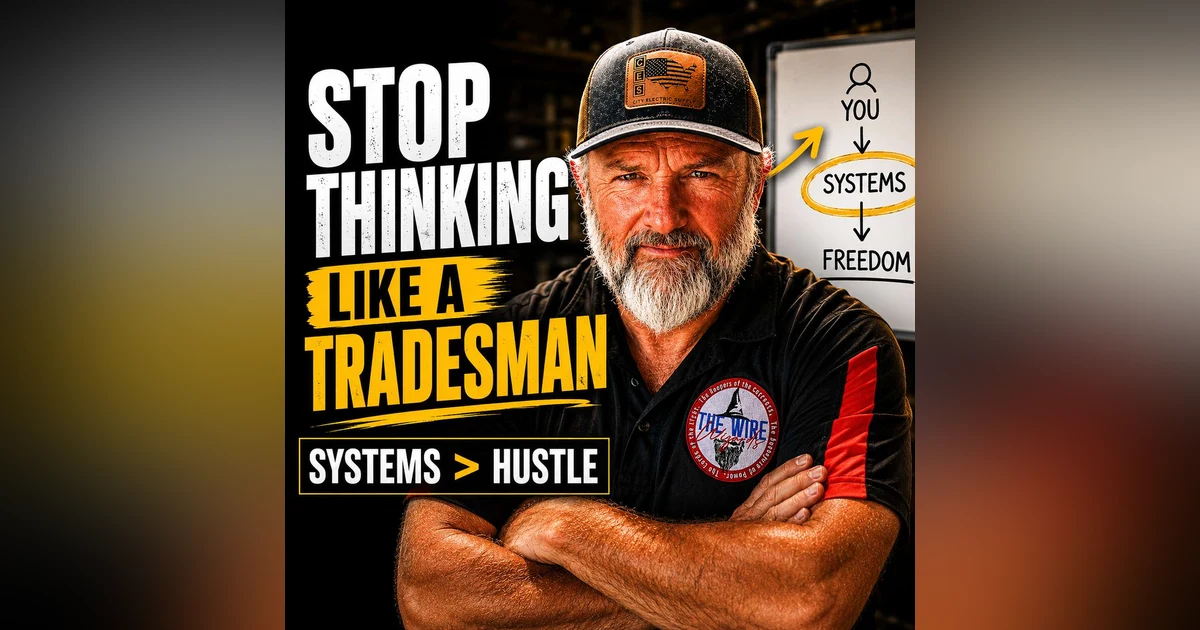


Want the exact Service Rate Tool and pricing system we use to build million-dollar electrical service businesses?
Grab the complete pricing walkthrough inside the SLE Pro App:
https://serviceloopelectrical.com/pro-app
See real pricing examples, service call systems, and premium option builders used by electricians across North America.
————————————
Most electricians think like electricians…
Fix the problem.
Collect the check.
Race to the next call.
Hope working harder somehow creates a better business.
Repeat until burnout shows up driving your service van.
Meanwhile…
We've coached hundreds of electrical contractors through the exact transition from technician to owner.
And most of them follow almost the exact same pattern.
Like Law & Order.
Same framework.
Different business.
Because great electrical companies don't feel like constant firefighting…
They feel like freedom.
But behind the scenes?
The best businesses are built more like operating manuals than heroic rescue missions.
In this video, I break down the exact mindset shift that helps electricians:
• build systems that don't depend on the owner
• create premium customer experiences instead of racing service calls
• increase average tickets through better conversations
• develop businesses that continue growing beyond seven figures
• think like business owners instead of technicians
Inside, I'll show you:
• The four-part growth journey Simon followed from commercial electrician → business owner → seven figures → first $100K month
• How cleaning houses unexpectedly taught him one of the biggest lessons in premium customer service
• Why most electricians stay trapped thinking like technicians instead of owners
• How to simplify business growth into repeatable systems instead of constant heroics
• The simple photo documentation system that turns expensive callbacks into profitable service calls
• Why expanding into a second location too early is usually the wrong move
• The secret to getting homeowners to trust you before you ever present a price
• Why "working cheap" is mostly rubbish if you want to build a premium electrical company
• How to create service experiences homeowners happily recommend to everyone they know
Also…
There's the story of Simon arriving in America with nothing but two suitcases.
A fifth of whiskey somehow becomes the beginning of his flat-rate pricing system.
Clay compares business owners to superheroes—and why that's actually dangerous.
And one conversation about slowing down with homeowners that completely changed Simon's business.
If you're new here, binge the channel.
If you own an electrical service business, use the framework.
If you want to scale to $1M+ with less chaos…
Watch the Million Dollar Plan below.
————————————
And if you want to see our Million Dollar Plan — how we help Electric Service Business Owners build $1M+ companies without becoming a slave to the truck, the phone, or the chaos…
Watch here:
• The Service Transformer™: The 4 Stages of a Million Dollar Electrical Business
You're good at your job, but you want to be better as a business owner. You're no longer an electrician, so you've got to learn to think like a business owner. Don't think like an electrician. Think like a business owner. That's deal towards success and get all the help that you can. This cohort, Service Loop Electrical, it's a wealth of information. This is kind of where you need to start. Took me five years to get here, so don't be on my side of the stupid spectrum. Started now.
SPEAKER_01Hello, hello, hello, and welcome to the Million Dollar Electrician Podcast, where we help home service pros like you supercharge your business and cook up those sales.
SPEAKER_03I'm Joseph Witani.
SPEAKER_00Now it's time for sales. It's time for sale. It's time to become a million-dollar electrician. Hello, hello, hello.
SPEAKER_01Welcome back to another great episode of The Million Dollar Electrician. We are Sans Joseph Lucani today, but we're with Simon Ben. And Simon, this is a super uh interview that I'm pumped for. You guys should be pumped for. Simon's been uh willing to jump on the show here and help you guys with his story. And as usual, these client interviews, uh, we never truly know where they're gonna go, but I know where we can start here. Simon joined us for our first ever case study group, which became Off the Tools Night School, as you guys may have heard of by now. And so we got to really get to know Simon in that group and what Simon's all about and some of Simon's potential because literally on the final call, he's like, Oh yeah, Clay, right at the end of the call. By the way, we just had our first uh 100K month, and it was so we were so happy for you, man. Super pumped. And I asked Simon before the call what he's most excited and most proud about in his company, and he said, uh, you just came over your fifth year. Is that right, Simon? Yeah. Awesome, man. And you said this crazy stat. Was it 95% don't get that far in their business, right?
SPEAKER_04I think it's 95% of businesses fail within the first five years, and then 95% of that five percent fail in the next five years.
SPEAKER_01Crazy. So you're feeling good because you got over that first five, that first hump. Yeah, and you're feeling good because you got some new systems and stuff. But why don't we take it back to the beginning, man? Tell us about your journey and why you got started with electrical in the first place.
SPEAKER_04So my background was I used to work in printing, so I've been running the big multicolor printing presses. Came to America, tried to get a job in that trade, but you can't because it's a dying trade. And in America, it's uh you can't get a job in management unless you have a degree. Well, I'm old school, we work our way up to the top, you know. And uh every time I'd open my mouth at a job interview, it's like, oh, he's got a really cool accent, let's put him in sales. And that's where I learned to deal with sales, and I hated it, you know. You're working for the almighty American dollar making machine versus uh people's sense of entitlement, and uh it clashed head to head, but it was meant to be because I met an electrician, talked to me about the trade, told me how to get into it, and gave me my first job as getting into the trade. So this kind of started there back in 2013, and then I ended up getting a job in a big commercial outfit, um, doing a lot of commercial work, and found out I was pretty good at it. By the time I was a second year apprentice, I'm basically running jobs. Then I was starting to do side work a little bit because people ask you, you know, can you just wire this in for me? Wire that in for me. Well, I'm a commercial electrician, you know, give me a piece of MC, I can tell you what to do with it. But when I see Romex, I'm like, what's this? This is a poor excuse of a wire. It's not real wire. But I didn't I didn't know anything about the residential side, so I uh jumped shipped to another residential company because they were paying more, learned a lot of uh residential experience there for about two years, got my journeyman's, then went back to the commercial company I originally started with, and uh got my first multi-million dollar electrical job as a foreman, didn't have a clue what I was doing, and uh got my ass handed to me big time, but I look at it in a positive way because I gained a lot of experience working for big companies, working on their on the like um multi-million dollar electrical jobs, learning how to run crews, realizing you can't be everybody's friend because they'll walk all over you, and yeah, just progress from there. The last big job I did working for someone was we have an Amazon building here in Colorado Springs, and it's huge. And uh, that was the worst job I've ever been on in my life. It was so cold, literally going home with icicles in your beard, you're so tired because you've shivered all day, and uh, people were headhunting me to go work for the other companies that we were working with, and that's when I had the great idea. Well, if they're headhunting me, they must recognize how much of a genius I am. So I should do this myself. So I had the great idea of setting up my own electrical company, and uh you start at the bottom, which they class as residential, and you think it's the bottom, because that's kind of the commercial mentality, and uh you uh you get thrown in at the deep end, learn to swim pretty quick.
SPEAKER_01You said a couple things there I want to call attention to. There's an underlying thread here I didn't know we were gonna get into. I knew we had some alignment, but you said like three things that really spoke to me and my journey too. And I found even when I started the trade, I was actually early 20s, still, mid-20s, new dad. I've always been a bit of a mature, kind of high on myself, I guess. So I was thinking like I'm 40 already. Like, is it too late to start a new trade? And I've dealt with that question with everyone in every decade. Simon, how old were you when you jumped into electrical? I was 40 years old. Way to go, man. There's so many guys like you that are like, nah, start a trade at 40, it's too late. I'm over the like I can't. No, if you're listening to this by chance, or guys, if you know someone who needs that little shove to say, no, there's there's something real here for you, please. Our trade needs more great, great people. And the second part that ties into that, you heard Simon say, like, because you brought experience, you excelled into leadership as a second year. I had the exact same experience. I had already run some projects in other domains, I had already made my some mistakes, not my mistakes, but enough mistakes to know better than just the average green apprentice. So to get an advance that fast, I mean, that makes it even more worthwhile. There's companies looking for you guys, if that speaks to you. Um, yeah, kudos to you, man, for jumping in so late and then realizing the the project woes too. We have that in common as well. Were you worried about it at 40? Did you have that same question, that same thought? Like, is it this too late for me, or were you just no, run rig for it?
SPEAKER_04Um, yeah, and yes and no. I mean, I came here in America in like 2006, no job prospects, nowhere to live. Came across here, we had a place to live, and all I came with was with just a suitcase, two suitcases of clothes. That's all I ever had. And you know, so I landed in Illinois, no idea of a future, but I'm kind of the guy who just says, All right, what do I need to do? Let's get moving. So I worked in my wife's cleaning company for a few years. So I was cleaning houses. I got really good at cleaning, you know. So all those stories about men can't clean up, hell yeah, they can. I can show you how we can clean up really good. But then you start to realize, you know, it's a business, so you start to see business sides of things, how you can improve it, you know, looking at marketing. I'd never looked at marketing before. Graphic designing came in handy there to design all the new flyers and the logos and slogans and stuff. And then uh I moved to Colorado, uh, try to get the cleaning company going there again, and it just flopped. So I ended up getting a job and working. My first job was at a Sears Auto, which I take great pride in because Sears is like such a great American icon, and that's what my first job was. So it was kind of cool to do that. But it's all connected, you know. I went from there to a big dealership as a service rider, and then I met the electrician, and here I am 20 years later on.
SPEAKER_01Yeah, yeah, this connected tissue. I mean, let's go into that for a moment. You're doing residential now, you're in business for yourself. There's a bunch around that uh transition, but how has the cleaning business helped you understand and improve your residential service? Do you think, Simon?
SPEAKER_04I'm sure all the business owners can relate to this, but how many apprentices do you have where they don't seem to see the dirt on the floor that they made, you know, and you're always snapping at them to clean up? So you learn attention to detail when you do something like that. I just did it because it was a job. I don't care, you know, digging ditches, cleaning houses or whatever. I'm just gonna do it so that we can bring some money in and support the family. That was kind of my mentality. Little did I know that it was teaching me to be, you know, a critical eye, to look at things in a clean way. How does a house should look when when an electrician leaves, for instance? Because that's the kind of goal that you want to go for as a boss.
SPEAKER_01Yeah, yeah, I strongly agree. There's this um kind of expression of once we know we know too much, you can't go back. I think it's something we actually talked about in night school a little bit, and changing your language, but changing your perspective is so hard. Like once you're an electrician and you know all the technical, it's so difficult to think like someone that doesn't. For instance, before I was an electrician, I can remember trying to fulfill on a home warranty thing. The general contractor I was working for, of course, sent the 19-year-old out to do the home warranty call, right? Leave the actual carpenters on site. Let's just send this guy to go schmooze this one over. And they had uh an electrical outlet that didn't work, and I knew nothing. I was terrified of electricity at this point in my life. I knew nothing. And I remember going in the phone book and like, oh yeah, Saunders, that was the guy. We used him before. I'll call him. Yeah, do you think you can fix this? Oh, yeah, no problem. I'm like, really? You haven't even seen it yet, right? Little did I know that any apprentice with a plug tester can figure out what's wrong with this uh outlet in this house, right? This receptacle. But at the time, like I reflect on that often to remind myself of what it was like to not know. And the reason I go on this this tangent is because the cleaning is the same thing, really. It is. It's like, do you remember what it's like to have someone in your home? And the attention to detail and the things that you notice when you don't understand the technical.
SPEAKER_04Well, I think a lot of it's to do with fear, fear of the unknown. Um, I think a lot of people don't set up in business. In fact, I got told um when I first set up, a lot of the people that I used to work with, you know, were mocking me. Simon will be out of business in a year. It's Simon, he won't be able to survive. And then I asked the guy I was in business, I have two partners at the time, and uh I asked one of them, well, why do you think they why the why do you think people are saying bad things about us? And he turned around and said, it's fear, people are scared of stepping out into the unknown and and taking a leap of faith and seeing what they can achieve. And those are the kind of people we stuck as a journeyman or a foreman for the rest of their life, you know, and even if we failed, at least we took that leap of faith and tried it. Yeah, and it was um, I think I I think it was uh a book I read that talked about most people who are multi-millionaires have been bankrupt multiple times already. So when I thought about that, I'm thinking, well, if they can become bankrupt multiple times and still be a millionaire, then well, I can do this, then it's easy.
SPEAKER_01Yeah, yeah, absolutely. Doubt and fear steal more dreams than failure. Yeah, yeah. I think I think Carmozy said this uh you need a failure wallet, and that thing needs to be fat. I love that expression, real thick visual.
SPEAKER_04It is, yeah. You can't learn if you're not making mistakes.
SPEAKER_01Yeah. What's something from the commercial and project side that you reflect on still that you think helps you in your day-to-day planning?
SPEAKER_04Um, you know, big commercial jobs, you had to plan your days out, plan your weeks out, do a commodity takeoff so you know what material you're using. Um, definitely that side of stuff. And another thing that I realize is how little they pay. So I'm not really bothered about doing commercial work. Um when we kind of looked at it when we first started up because I knew I was pretty good at organization and running a job. But then, you know, when you get told by the project, man, just cheapest bid wins. Well, I don't want to work for cheap anymore. I'm tired of working for cheap. So you learn, you take some good skills, but then you also learn the bad side of the commercial world and shy away from it.
SPEAKER_01Yeah. What would you say then over the first year or two? What was your business like then versus now?
SPEAKER_04Oh, it was like by the seat of our pants within the first year, you know. We'll do anything first year. We did a commercial job. I think we did like a $30,000 commercial job for $10,000 because we didn't know what we were doing. Right? So we learned about that, you learn about lighting packages, you learn the project management side, which you don't really get to see when you're a farmer in the field. So you learn that, um, and then just juggling customers rather than having a structure, it was everything was by the seat of your pants, and it's little by little that you start to fine-tune your system. And I found you know, we can fine-tune it so much because uh six months into the business, I realized I knew nothing about business, so there was a lot to learn with that. Um, and there's a lot of back-end stuff that goes on for businesses, you know. Uh, and then I'd say like a year or two years probably into business, we kind of realized flat rate pricing was a good thing. I remember sitting down with a residential contractor who ironically I'm meeting today. We drank a fifth of whiskey and we've managed to knock out some residential flat rate pricing. And when I saw that flat rate pricing makes a lot of sense, makes estimating a lot easier, it makes walking jobs a lot easier. Because if I have a rough idea what it's gonna cost me, it makes estimating so much easier. So, you know, then you start getting into the oh, so you get the opportunity call, go out. Oh, your outlets out. Well, I can just replace that outlet right there for 250 bucks for you. Wham bam, thank you, man. Here's my 250, and you leave and go, and that's it. And then I think it was at the end of the fourth year, we just did our first seven-figure year. Nice, congrats. Yeah, it was okay. We were handling a lot of like general contractors as well, in the sense that I had all these clients and they wanted stuff being built inside there, and I didn't want them farming the work out to other general contractors, bringing in their electricians. I wanted my people in there to retain my client. So we started handling general contracting work. I think we did like a hundred thousand dollars in general contracting work, and then we're putting a 10% markup on it from not doing anything, but it kept my client, kept my guys there, plus we made 10% from not doing anything. So the first million that we hit was kind of a fake number because it was like okay in general contracting as well. But now, well, now we're gonna, I think we're gonna blow that out of the water right now. We're not handling any general contracting work right now, but it was just an opportunity for me to delve into something I'd never done before, return my client, and I'm still working from today because of that. I think.
SPEAKER_01I think that's pretty well one of our main pillars here is that conviction to the customer, the end user just serving them at the highest level. That that's kind of our big values realization, and everything that we do is just service at the highest level to an individual, which is really hard when you have a list of hundreds and eventually thousands of people actually. So it takes these systems and everything that we'll get into night school and the rest of it. But let's stay back here for one more moment. Just help me understand what do you think got you through that first year or two? If you're looking back at it now and kind of not condemning it, but of course, we all do, and we think, oh, that was kind of stupid, or that wasn't great of us, or you know, what was it that got you through then for those guys that are in that mode now?
SPEAKER_04Oh, I just have one of those stubborn mentalities. You tell me I can't do something, and I'm like, hold my beer, I'll learn how to do it as well. Um everything, everything I've ever done, I've been self-taught, and I've always been very good at it. Like in the printing world, I was one of the best printers around in the area, and people would headhunt me for that. I would um just learn something to the best of my ability. If I get a a like a hobby or something, like I'm a Christian, so studying apologetics, I like to debate and learn to think using logic. And learning apologetics was another thing where you just you push yourself. I bought myself a Jeep, I didn't know anything about vehicles at the time, but I'm gonna learn everything I possibly can. It's my wife tells me I'm on the spectrum, and I must have this really weird ability to do things really well because I'm on the spectrum.
SPEAKER_01Yeah, welcome to the club, man. Right.
SPEAKER_04I don't know if she's telling the truth or not, but it's with my wife, and the best thing to say is always yes, dear.
SPEAKER_01Yeah, yeah. I think uh I'm learning some of that from uh some gents around me here now. When to be quiet, when to say yes, dears. Um you mentioned something there, you love the debates and the like, something we've had as a common thread internally with some of our guys, Austin, Daniel, etc., has been this conversation around critical thinking. It seems very common amongst successful entrepreneurs that we are critical thinkers, meaning we try to take an objective view, we try to challenge knowledge that comes forth, especially if it's just emotional. Um what's the word I'm looking for? Intuitional kind of data when people present that. How big do you think that's really been a part of your growth and and your success so far?
SPEAKER_04I think it's been a very big key development um to be good at this job, especially. A lot of my my previous business partners, um people I've worked with apprentices, they call me the wizard because I can literally walk into a building and tell them how it's wired just from looking at it. But it's just a logical process you follow. Um and I think with electricity, I mean it just follows a logical process, how it works. So I think it's pretty key in that sense. Um and you're able to become a good troubleshooter when you're able to think like that. You know how a GFI works, so you know what it should do, how an at halt works. So when you've got that logical process, you can follow it and then work out what the actual issue is.
SPEAKER_01Nice. Yeah, I love that. And so many people that listen to us are getting that figured out or have that, they feel confident in their electrical abilities, but not quite yet. Maybe the business, the systems, the lead, sales, and installs, the office. What do we do? How do we do it? How do we really take care of a customer? Are you starting to see that logical process become clearer? Do you notice that over the five years for business and what this really is through the windshield?
SPEAKER_04Yeah, I would say yes, but then don't expect it because sometimes businesses will have like a surprise for you. You know, you make you make relationships. This town, especially, is very big on relationships, so networking is pretty key. You build the relationships up, you have a good referral group that you refer out, so it's still your people in other clients' houses. You build all these up, you get to know one person who maybe we're in Colorado Springs, he does a lot of work in Denver, and you're like, oh well, logically, I could go to Denver and start to expand into there and set up another office, and logically, it makes perfect sense, and then you start to see it makes zero sense, you know. So don't be surprised if your logic or what you think is an open door really isn't an open door because there's a you've got to get your system down where you are, logically get that cemented in place. And I thought I was ready for growth you know a year ago, but now I'm starting to see we're not because we need to have systems in place, the guys need to be trained out there, they all need to know the processes. I think it was um Tommy Mello who he asked one question on his podcast, he said, uh, what's your business worth? And you think, well, three and a half times your gross revenue, so you know if you're doing a million, it's three and a half million. And then he says, Well, can your business run without you? And the answer is, Well, no, I you know, I've got to run the business. And he says, Well, your business isn't worth anything, and that kind of hit me, you know, and uh it was an eye opener for sure, and then you start to look at yourself and see, well, logically. Kind of I'm in the wrong place. So now you start to look into developing systems and getting the business to run without you because it's a business, it's a separate entity. You're just the guy there who sat in the hot seat, but it should be able to run without you. So now we're starting to look at the way our business runs and trying to get all that trend up. And it's a lot harder than I think people think it is. Um sometimes it is the look of the draw with the people that you get.
SPEAKER_01Yeah, yeah, I would agree with that fully. I can't remember if it was in a class or which one, but we had this conversation the other day about how the world looks at the superheroes wrong and how that impacts your business and the way that you were talking about it. Like we think it's a good thing to be Superman, we think it's a good thing to be Batman, and we forget to question what would happen if they were gone. How did they empower the environment to be better so they wouldn't be necessary anymore? Right. And that's where the whole thing collapses. And it's we've kind of named this thing. There's a joke going around. I don't know if you saw the Daniel actually made this freaking meme of my face and a chunk of broccoli and a cup of milk. Did you see it? Yeah. The broccoli and the glass of milk. But that that metaphor serves us. And when we get to what we call the bench, which is typically around where you're at, 100k plus months, and definitely before the 200k months typically, you tend to really face these challenges of, oh, I'm ready for growth. And every time you try to expand or scale quotation marks, um, we tend to hit our head on the ceiling because we realize, oh crap, there's another spot that I'm required. Oh crap, here's another place where I just saved the day. And I was proud of that in my old model, but now I have to actually write this down on what I call the hero list. So all those things where you save the day actually need to be done by someone else, otherwise, you're gonna be strapped to this thing.
SPEAKER_04Well, it's a simple thing, uh like uh systems, for instance. You know, it's always a case of hey boss, we've got this issue going on. How do we fix this? I cap on a lot about um troubleshooting, and I've been that can be a real dick to my guys sometimes because I'm always out of na na na na na na like uh they called me the I'm sure they call me the work wife, but uh it's a simple thing, like like a 240 outlet. Did you check it line to line and then each line to the neutral to make sure you've got your proper 120? The kid never did, he lost his neutral when he put it all back in, and it's stranded wire. You had to do what I call the jiggle shake where you shake there, retighten it, shake it again, retighten it. Most people don't do that stuff, and he forgot to do it. So if he'd have power checked it, he would have found he lost his neutral. So again, he got a call back. I had to go out and fix it, and uh he was kind of upset about me pointing it out that he did it all wrong. But then I said one thing to him, which was show me the photos of your your power check that you did to prove that you actually power checked it. And obviously, he didn't have them, yeah. So, you know, that he took that kind of person line and he thought about it for a few days, called me back up and apologized about it and said, You know, you're right, boss. And then just yesterday, I had two callbacks. One was because they never checked for a GFI in the bathroom that should have been working. The other callback was this kid again, and uh they'd lost a neutral on uh garden outlets, GFI outlets in the garden, and I had 90 volts. So I said, Hey, did you uh have any pictures of this? And he did. So he sent me all these pictures of him actually testing and checking it so I could show the client that hey, everything was working when we left. That would have been a well, we have to fix it for free because we were the last persons who touched it, so now we have to fix it for free. But because we had those pictures, we were able to turn that into an actual another service call where he pays us for our time going out there, and it's such a simple task, just a little system like that makes you even more money.
SPEAKER_01Yeah, yeah, yeah, exactly. Really well put. Do you guys use a checklist at all? Or these uh kind of mental systems at this point, Simon?
SPEAKER_04Uh yeah, we're kind of going through CRMs right now. We've gone through service fusion, we're in field pulse right now. Field Pulse doesn't do a checklist, so I'm driving it into my guys manually right now. I want photos for every job showing me that you've checked it. Yeah, simple things like GFIs on AC circuits. You know, if you go AC with a GFI outlet, show me that you've tested the GFI outlet. Because sometimes we go back there and you know the customer says, Well, it was working before you guys touched it, and my guys are adamant that they power checked it, but where's your photo? So just simple things like that. It's just little systems that make a big difference.
SPEAKER_01Have you ever used uh company cam?
SPEAKER_04No, I haven't. I know it's another one you have to pay for, and I'm getting tight players tired of spending money on this and spending money on that, and it's just as an FYI though, it's worth looking into.
SPEAKER_01Most people uh are back in that one, it's really popular, but it it does the photos, but also checklists where the photos can literally be required for the checklist to complete a job. So a lot of our guys find that that's really useful for installer checklists. So it might be worth the splurge, at least looking into get a demo, brother. Uh not not sponsored by um company camera at all. We're open to it, guys, if you're watching. Uh yeah, yeah, we should be. Uh, one thing you said uh prior to the show was business changes a man.
SPEAKER_04Yeah.
SPEAKER_01What do you mean by that?
SPEAKER_04Well, you change the way you think, you act differently. Uh, when I uh was falling out with the business partners, they were all trying to say how the business has changed me is kind of like a slur, it is a negative thing. But they're right, the business has changed me. It's just it makes you more focused. Um, I think it makes you more of a grown-up and more responsible, to be honest with you. Because a business does change you, it you have different priorities, you you look at things differently. Um, and I think people who don't want to grow up and be mature and responsible and and uh will just basically get left behind, which is kind of what happened. I think real business owners will actually change. I think those people who don't change are probably not meant to be business owners, in my in my opinion.
SPEAKER_01Yeah, that's really interesting. Uh many times we've said your business is a reflection of you. Would you agree with that statement?
SPEAKER_04Oh gosh, I hope not. My hair is always a mess. Um that's why I wear baseball caps. I've got these funny things that grow out the side of my head, and I wear baseball caps to so uh I would say yes. I would say it's an extension of your core values, like our core values, something that we've just nailed down, I would say, in the last month. And it's definitely a refresh a reflection of me. You know, integrity is a big thing, honesty, owning mistakes. Hey, we all make mistakes, but let's um own them and fix them straight away. I think if you do that, you'll get a lot more respect from from companies that you work for, especially. You know, if you mess up on a general contractor's job, say you open the access door to an attic, you break the drywall access panel and just leave it to one side, then he finds out at the end of the job you were the last ones in there and broke it. What's he gonna do? He's gonna look at you like you're an idiot. Whereas if you just call him up and say, Hey, uh broke this when the drywall has come back, and you get him to throw another piece in there, he's gonna appreciate that because you make his job a lot easier. It's easier to fix mistakes. So I think, yeah, a business is definitely a reflection of who you are as a person, especially on the moral levels, as well, you know. So you gotta make sure you've got have good morals because you want the integrity and the honesty. Um, we see a lot of big companies here using fear-like tactics to sell rather than give the options. You're trying to talk somebody into oh, your house will burn down if you don't change all these outlets out. And it's it's a fear tactic. We talked about it. It's like how do you present them? You know, we present them as options, not as a fear tactic. It might be the same conclusion, but the presentation's different. So for me personally, it's yeah, it's it is a reflection of you as a person because you don't want to scare people into buying your product, you just want to be honest with them and present them the options. You empower the client that way, I think, as well.
SPEAKER_01Yeah, really interesting. Can you go a bit deeper on that? So, how do you see the options um staying out of the fear tactics, in your opinion, then?
SPEAKER_04Well, you're a professional, like I've I've been realizing recently it's it's not about who you know or what you know, um, it's about who you are as a person. I mean, if yeah, I hire an electrician to fix an issue. Well, I expect he knows what he's doing. So hiring me as an electrician, you should expect that I know what I'm doing, which is just you know half of the course. So, what makes me different to everybody else? I've been seeing these adverts on Facebook for Alex Minor. He keeps saying, Why should I go with you? What makes you different? And that's been a question that's stuck with me for quite a while. What makes me different? Um, because what I know, well, everybody knows how to fix an outlet as an electrician. So what makes me different? Why would you want to go with me to fix an outlet? And I think it was you and Joe were talking about slowing down with a client, and I've started to do that, started to slow down. Um, I used to mourn at my guys for taking two hours to do a job walk when I could do it in like 15 minutes, you know, and now I'm realizing that they were right when I was wrong. So now I'm I'm spending time there, I'm talking to them. I literally had a woman just uh this week on Monday thank me just to stop and talk to her. We were talking for like two hours about children and just life in general, you know, and she just thanked me for listening to her, and I ended up getting the job. It was just to install four simple cameras, and it was it was a nice simple job. I think when you start to be slowed down, you bring in value straight away. I mean, you turn up in your shirt, you look nice, you have your baseball cap on because you've got bed head. So, yeah, there's that's where it starts. Your presentation, they like you, and then they hear my accent, and oh, they really like me. Then you bring in the value to the conversation by literally having a conversation and treating them like a person because people still need that connection, you know, in this world where we're so connected, you can get so far apart, we lack the one-on-one communication. So I've slowed down with customers. I was doing a job walk for a panel upgrade the other day where I was literally there for nearly two and a half hours talking about everything under the sun. We got talking about family and reverse water osmosis systems, uh, we stay away from the politics, um, just those relationships, then, because now I've built that trust, they know who I am. You said it that they know a person who they know, like, and trust. Well, how do you build that without having a conversation? So now I'm starting to build that. Now, when I present options, for instance, they already know, like, and trust me, so they're gonna listen more to what the options are that I'm presenting. Yeah, really good.
SPEAKER_01Nobody cares how much you know until they know how much you care.
SPEAKER_04Yeah, and it's just sometimes it's nice just to slow down, switch off, and literally just talk to the customer as if they're just somebody you've passed in the street.
SPEAKER_00Hey you guys, if this episode sparked something for you, imagine stacking that every single week. That's how businesses stop flickering and start running steady.
SPEAKER_01If you subscribe to the show or leave a review if you're on an audio, and if you're driving on the road, please pull over when it's safe because I've got something you're not gonna want to skip.
SPEAKER_00For every person that subscribes and or leaves a review and fills out the form below, letting us know that you did that thing, we're gonna draw one monthly subscriber for our open circuit lifetime membership worth $1,500.
SPEAKER_01And that's not enough.
SPEAKER_00Every six months, we're actually gonna draw another subscriber for our $5,000 scholarship, which you can use for any of our electric service packages to get your business and your service rocking better than ever.
SPEAKER_01Come on, guys, let's brighten this thing up. Is it gonna be you? Back to the show. I'm gonna circle back to a point you made earlier about fear. I suspect the reason most electricians won't give themselves permission to do this very thing you just said is that we actually fear not being accepted as the human, and we hide behind the cape of the electrician because we feel safer in that authority than we do just person to person. And it asks this question every time will you like me? And we don't want the answer a lot of times. I I've seen this in a lot of people. What are your thoughts on that? Fearing the actual just person-to-person acceptance hiding behind the trade.
SPEAKER_04I've talked a lot about this with a friend of mine, he's a realtor, he's the most outgoing, extravagant, likable guy you'd ever meet. And he has a serious hang-up about whether people like him or not. And I'm looking at him going, well, how could they not? Because you're awesome, you know. And um it's it's strange to me because I don't really have an issue with whether people like me or not. And maybe that's a cultural thing. We come from an old mining village in England where we still say the and thou, you know, we're very archaic in our language. In fact, this is not even my real accent, so it's um, I think it's more of a cultural thing here where you've got to have this acceptance of who you are. I don't seem to have that. I that I say, I say that now, maybe on a lower, deeper level, I might have some of it.
SPEAKER_01Well, don't let me place it there. Don't don't.
SPEAKER_04Um, yeah, I don't know. I just I think the first thing for me personally is I don't care whether you like me as a person and I need to feel accepted by you when I'm talking to a client. I don't have that issue. And the reason being is I walk in there with the confidence, I know I'm good at my job, I know I have value and honesty, and I'm gonna tell you exactly what you need. Um, I'm not gonna try upselling you and using fear tactics. I've seen how other companies work, and I know that my company is a lot better than their companies. Um, I'm not gonna do any kind of shady stuff and try getting one over on people. So I walk in there with this confidence in who I am as a person, which again, you know, your company should reflect you as a person. So my company is gonna reflect the values that I have. So because I walk in there, I don't really have that issue. I mean, I think you remember like when we were kids, and you've got to go ask a girl out, and or if she says no, who cares? I mean, you've got nothing to lose right now, right? She says no, you've not lost anything, it doesn't matter, just go ask her and find out. And it's the same mentality with my company, I guess. Because I mean, we get told no on a lot of estimates, or you're too expensive. Okay, you know, it's a numbers game. Yeah, we're just not the company for you, man. That's that's all it is. Uh, and there is a lot of people, they're always looking for cheap. I don't work cheap. I think too many electricians in this town have devalued themselves to such a degree that I can see on Facebook guys are fighting for $30 jobs. Yeah, I don't want to work for $30.
SPEAKER_01Yeah, solve the bigger problem. Why are we fighting over the job at that rate?
SPEAKER_04Yeah, yeah. Are these towns saturate with electricians for sure, but there's kind of that fear element, I think, where they're scared of saying no. I think it was you that said, you know, make no your favorite word, which I have done, and I don't have a problem saying no to people, and um be confident in who you are. The fear side of it, I see, is it it you have to take a leap of faith when you set your business up. I mean, you're gonna set something up, you've no idea how well it's gonna do. Um, you you can either take this leap and see how good you are as a person, or you can fail or not do it. Um, the fear stops people from trying to do something that's gonna benefit them. I think everybody should be self-employed. I think it's awesome. Fear stops people from doing that and keeps them crippled as a W-2 and keeps them basically as a slave to the system. I hope my employees aren't listening to this.
SPEAKER_01Well, it takes all kinds, and it's also a timing thing, right? It's not necessarily that today is your time either.
SPEAKER_04Well, I think it's a character thing as well. Like, are you the kind of person who can go big or go home? I mean, I've like I said, I came to America with nothing, two bags of suitcases, didn't have a clue, moved to Colorado Springs and lived on the side of a mountain in a tent for two months. Who are you as a person? I think those kind of moments show you your true character, and a lot of people don't want to see their true character. That's what I think the fear hides.
SPEAKER_01Nice, nice circle back, man. Good, those good craft there. Yeah, and that I think business owners really overlook. We tend to live in fear about well, is there enough electricians? Where will I get guys from if my guy leaves to do his own thing? But great electricians actually come from three places. Uh, great people who aren't yet electricians or aren't yet ready to take on leadership for you, which is awesome. Let's find them and grow them. We should be trying to do that. Um, people who don't want to go in business for fear or other reasons. There are a handful of people that don't want it. They just want security, they want to be appreciated, they want to be part of a winning team. And there's also the guys that go and try and don't make it. Yeah, we should be friends and taking them for lunch too, because it is hard, and you guys know it's hard out there. So support your brothers. If that person doesn't make it and they decide to become part two, which was, I don't want to be in business anymore, help me be an entrepreneur instead of an entrepreneur, then you win that battle too. Yeah, I think not enough guys see the bigger picture here. Like we ought we got we ought to buy all those guys lunch and keep our Rolodex full and keep those relationships warm because everyone is looking for uh you know the next great thing without conflict at some point.
SPEAKER_04Yeah, there is. I just don't I think there's more bad electricians than there are good ones, to be honest with you, especially in this town. Um, but I yeah, 100%. If you can find people who are good people and train them to be even better electricians, everybody wins.
SPEAKER_01Yeah, you and I have that in common. I have that same belief. So you were rushing calls 15 minutes. Holy cow! Like that's pretty fast, right? But you mentioned I think that probably would tie into that flat rate convenience and just knowing the price and being able to say, hey, sometimes boom, this is it. Take it or leave it. Were you at options before? What was your presentation style before to be able to run uh the odd call in 15 minutes? I'm sure they were.
SPEAKER_04I didn't realize what my presentation call was like until uh we were on the cohort, the alpha cohort. I would just say the alpha Simon is alpha, let it be known as an alpha player. Not you cohort betas, by the way. But it was uh Joseph Mamina was talking, and uh he just dropped it like a serious truth bomb, mate. Oh yeah, just one of those guys, I'll get in there, find your problem, get it fixed as quick as I can, take the minimum amount of money, and I'm gone. And that kind of hit me. I'm like, that's exactly what I've been doing. And then I realized that hey, that that's kind of stupid because where's the value?
SPEAKER_01Yeah, that's how we end up being one of those argue over the lowest price guys.
SPEAKER_04Yeah, but it was um, I think what happens, especially when you're growing a business, you've been talking about it recently, you know, you get to your first 400k and you're doing really good, seeing growth, and then you get to like your 600k or your 700k, and you're still seeing it, and then you start to get into the realm of the seven figures, and when you hit it, you're like, Ah, I've hit that goal, and you're so deflayed because now what? You don't go anywhere, you see. Your bank account is just it's plateaued, so you know we've got to do some changes because I've got so much of this revenue coming in, but the profit is dropping, and the bank accounts just plateaued. So now what? And you I think it was like three or four months. I was kind of just wandering around, stumbled upon Tommy Mello, listened to his. Then you think, okay, let's see if any electricians are doing what Tommy Mello's doing. And I didn't find you guys, first of all. I was I found another guy who does power washing. I think he's called Million Dollar Home Service. And he started to drop some stuff. That's that's kind of interesting.
SPEAKER_01Oh yeah, HSBC Home Service Business Coach or whatever. Yeah. I can't remember.
SPEAKER_04He's close to me. Yeah, Norman or somebody like that, his name is, and he was kind of cool to listen to. And then I I think you just popped up on an advert, and I'm like, oh damn, it's just what I'll be listening looking for. An electrician who's done it. And it was I think Joe was just talking about options. And you know, when you have like you're stuck in like a certain mindset, and you you you feel trapped and you don't know where to go, and it's like a left-right turn, you know. You which way do I go? What do I do? And you don't know what to do. And Joe just dropped some stuff about options, and it was just like a light bulb mom for me. It was like, oh my gosh, this is so simple. I need to learn more about this. Hence when we joined the cohort, uh listening to all the podcasts. I mean, I went right back. I think your very first podcast was like Rise Up or Rise or something, it was called.
SPEAKER_01Yeah, Rise to Rise at first. I was stuck in my own technical brain coming up with that thing. And it was Electricpreneur Secrets, and we realized no one can say Electricpreneur Secrets. Yeah, we went through the whole arc with that. Yeah. Yeah. Here we are.
SPEAKER_04So yeah, and it was just a case of you find that information. There's a lot of information out there you can find as a business owner, but you're not taught where to go for it or what to look for. I mean, the fact that I just stumbled upon you by chance, that was such a godsend for me. Because you get you get stuck, you hit that seven-figure revenue, and it's like, now what? And you wander around aimlessly, and then you get listening to you and Joe, and and then listening to everybody else on the cohort with ideas. And I mean, I was listening to one of your podcasts the other day, and I never thought about doing options on panel upgrades, you know. And it's like, well, why am I giving away a 40, 80 space panel for the basic price? Why am I doing that? Why am I not splitting it into options so I can get three or four options? I'm giving away value there that I should be selling and making money on rather than just taking care of the client and looking after him being a nice guy. Okay, cool, but being a nice guy doesn't pay your bills at the end of the day.
SPEAKER_01Yeah, yeah, been guilty of that too. I've done some nice stuff. I think I think everybody has, yeah. Hey, let's do this job for free because it'll come back to us. Yeah, oh yeah, I've had those thoughts. Please, guys, if you're doing charity work, just do it, but budget it and your pricing. Literally, I I encourage it. I encourage you to do well so that you can help people in need, but be logical, be calculated in that so that it doesn't cost you it's part of the plan.
SPEAKER_04Or if anything, don't give it away for free. And you know, you could turn around and say it's hey, look, you know, I'll give you this job for free, but it's gonna cost me, but I kind of need something back in return. How about going to all these links giving me five-star reviews? So try getting back some value in some way.
SPEAKER_01Yeah, yeah, there was something brought up in class this week, Monday, marketing class. Um, and what happened is one of the guys did have an excellent call. I think it was from a third-time customer, and so the boss, the owner, gotten uh hold of this information and said to the guys, like, hey, take a picture with that person and use the words they used or whatever, and let's do a post in the community group. Well, this homeowner did it for them and it blew up, and so all sorts of feedback. So if you guys can get your homeowners to do a post in a popular group or on their page on your behalf with a picture with you, like that is one of the best, most believable testimonies you will ever get. Yeah. Um absolute fire, and that's the kind of stuff that gets your name said in those groups often when someone says, Hey, who do you recommend? Yeah, yeah. Yeah, so really good point. So, what do you think then? Why did you decide, you know, at this point, four almost five years, were you hesitant? Why did you ultimately decide to give this cohort, this case study group now known as Off the Tools Night School, a chance?
SPEAKER_04Because I knew that I had taken the company as far as I could with the knowledge that I had. I knew that I needed help because you don't know how to like I said, six months in, I realized I knew nothing about business. It took me four years to start to understand how business works and welfare, unemployment, and insurance, and all the other garbage that we have to pay. Um, so you get all that down, but you still want to scale and grow. And I had no idea what I was doing. I mean, you can't just sit back thinking the phone's gonna ring, your customers are gonna come in. Um so what do you do? You know, it's it wasn't a fear thing, like oh, I'm scared away, my next job's coming in. No, I've always been provided, we're always busy. It's definitely by divine appointment for me that customers call me all the time. And um, but you still want to get the business down to grow to to dominate a market. I want I want to scale and grow and be number one in town. I really do. I have that hunger and that desire, but I realized that I didn't know how to get there, I didn't have a clue how to get there. You know, you hear stories of people saying, Hey, if you want to be a millionaire, go hang out with millionaires. I'm a blue-collar worker, I don't know any millionaires, you know. And the guys I do go to strip clubs, and I don't want to go to that kind of stuff, so I'm like, nah, I'm doing good with that. And then the people that I hang around with are just like me, just regular average Joe workers. We're not multi-millionaires, we don't know how you know to play the business systems and be successful. I I winged this for the last five years, but you reach a plateau where you've got to say, This is as far as I can go. Now I need to learn more in order to take us further. But I had no idea where to go to learn more. So that's you know, you hear it, it's a constant story on the recent podcast with everybody where you hit that plateau and we just stumble upon service loop electric, and it's like, oh my gosh, this is what we need, and it is. It's you guys have a system, you guys have a plan, you guys have information. It's like drinking from a like a uh a fire hydrant when you when you start listening to you. You have to go back and play the podcast all over again. I've got a guy who's looking at me right now. Uh he thinks I'm a successful company, and I I I would say we are, but he looks at me as this really great successful company, and he comes to me for advice.
SPEAKER_01Awesome.
SPEAKER_04And I ended up telling him, I said, So you're in your first year, you're about four months old right now. The best advice I can give you, go listen to Clay Newmeyer on Service Local Electric Show. So he's listed to you guys non-stop as well, and he's yeah, and it's cool because that's what we need is just information. How do we do this? I have the passion to do it, I have the drive to do it, I lack the information. So it's not something you can Google. How do I become a millionaire as an electrician? Maybe you need to clone that or claim that on your Google search.
SPEAKER_01Yeah, there we go. Regis, who wants to be a millionaire? Yeah, yeah, yeah. Uh, that's an old play. Nostalgia there. Were you um, I think you were one of three people then around the seven-figure mark or above in this cohort. Did you feel like it was too basic for you, Simon, or were you kind of glued to it front to back? Tell me that experience, honestly, if you don't mind.
SPEAKER_04I had a few technical issues, so it was kind of I was kind of late a few times, so I missed the beginnings. I felt bad because it's like you want to show up, you know, and be present. And I felt like I wasn't being respectful to you and Daniel because I was late a few times, so that kind of annoyed me. Um, the options thing kind of was Joe, obviously, you know, was just timing was wrong with Joe with his his heart attack, and that was kind of sad to see because I love Joe, and um I couldn't go to his classes because the timing was wrong, so that that was kind of oh damn, you know. It was a good sales ploy though, because now Daniel's talked me into going up to the next level.
SPEAKER_01Yeah, we've got a few people convert, though. It's good.
SPEAKER_04I think it's good, Claire. I I I thought it actually it was better than good, it was freaking awesome. Um, it was the camaraderie, it was a room full of other people who were just as clueless as me, looking for help and answers. So you don't feel like you're a retard. I'm allowed to say that on a podcast. Well, anyway, I'm said it. Um, you don't feel like you're in you're you're the only one there who's clueless, you know. You're seeing that with the business owners, and then I love seeing people so seeing the success of other people. Scott had a great success. I love seeing that, and then Job talked about his success at the church. That was freaking awesome to see, and that is like fuel on a fire. It's like, oh my god, if they can do it, why can't I do it? You know, it works for other people. You want to get out there and do it. So that was the best part about it was just the fellowshipping with people who are just like you, in the same boat, same mindset, same ideas and dreams, and they want to go forward, you know, and some people having more success than others. Well, success, ebbs, and flaws. So, you know, great for them. And I'm glad I got to share in their success. But even that, I mean, just being able to learn from people like yourself and Joe and listening to other people's stories is a success in itself because you realize you're not on your own out there.
SPEAKER_01Yeah, I love that share. And I want to be honest with everyone, including you, Simon, always do. This literally was a case study group. Like, this is the first time we've ever done this. I've never brought in a group of people and done anything like that. We traditionally did one-to-one. I think I've told you that a few times now. But just so everyone listening knows this. We have a new mentor or a new coach who we love dearly, and he's all about the cohort structure. So we literally were like, Okay, we're gonna try this, and we just didn't even know if we could get 15, or I think we had 10 people on yours, 10 or 11 people at once, all at the time.
SPEAKER_04I dropped down off.
SPEAKER_01Yeah, a couple people um fall out by the end, but ultimately what happened that for us was like, Oh, here's your sign. You had your first 100k month. Scott, who you mentioned, had his like a hundred and eight thousand dollar sale during that time using some of the very stuff we taught. Uh, Joe, Joseph, who you mentioned, that church was like a lighting fixture call that turned into a two-phase $100,000 job. Because and he was telling me this on Friday, the same things you just said. It was like 90% two-hour conversation, 90% personal, 10% work, and it just led to all this other stuff. Um, man, we're so thankful. The total wins tally for this case study was over 400,000. Oh, I'm gonna tap it.
SPEAKER_04I'm on my way to I'm at 155 right now for this month. What?
SPEAKER_01Yeah, yes, it's a live drop. We can't plan that, right? Like, so that's what you meant earlier when you were like, Oh, I'm seeing a much bigger future than what we had for the last year.
SPEAKER_04Yeah, but even this, the most so it doesn't have to be about figures. It's like um, you know, measurement tool. That's all. Yeah, it's just a number. Like, what do they say? Revenues for vanity, profits for sanity. That's a big thing we need to get. The first win I started to see with options was uh main breaker on a Siemens panel was buzzing, on its way out, just needs to be replaced. Doing a typical Joseph Mamina had been in there, swapped that sucker out, taken my money and left. Well, no, I gave him options, you know. I just talked him into a service agreement. He didn't want the service agreement, but because we're building options, I added a um search search protector, not that just a regular 10k plug-in ones for like a hundred bucks, but no, I sold him a big one, so it was not a once and done, it could take multiple hits. That was a sale that normally I wouldn't have had. So a success isn't about how many hundreds of thousands, it's are you bringing more value to your tickets? It's an average ticket value. And I'd start to see mine creep up because I'm getting a little bit here and a little bit there, and those little bits all add up over the space of a year, and that's success, in my opinion.
SPEAKER_01Amazing, man. Yeah, we keep getting these signs that we're on the right path. I mean, we're a business like yours, like any other one. We have our lows, we have our highs, we have our team meetings where we try to decide are we on the right path? Is this the right next move? We never know, but I can tell you in the last few podcasts that we keep having people drop these big wins for the first time. We our team has even heard of that. So thank you so much for that. And you mentioned just the options again, how important that is. Is there anything else that you took that was massive from this, Simon, that you would say is like a key driver to these these bigger months than ever? Or is it literally just the creation of value, treating people uh with more time and and more care and the options? Uh yeah.
SPEAKER_04So, like I mentioned before, I'm a theology nerd. I love theology, I like to debate argue. And one of the things you do in there is you navigate the conversation, you learn how to steer people to where you want them to go to learn to think the way through it. Well, why didn't I do that just talking to a customer when it comes to electrical? I mean, I'm already doing it. Why am I not doing that? So listening to Joe talk about how to navigate conversations and answer objections, it's like I really am kind of stupid because I'm already doing it, and yet I gotta listen to Joe tell me what I'm already doing that I should be doing right now. So, yeah, I'm kind of I'm a I'm definitely on the spectrum on the side of stupid because I'm having to listen to other people tell me what I already know how to do, but why aren't I doing it? So it was kind of cool to listen to Joe and yourself give me a kick in the pants to say, Come on now, sort yourself out. Come on, you know what you're doing, get on with it.
SPEAKER_01Totally. Yeah, I love that. And you're definitely on the side of uh, I don't know how much spectrum in, but you're definitely on the side of uh I've got my own spectrum who are hard on ourselves, right? So uh we'll allow the self-talk, the negative self-talk this time. We'll we'll talk about positive stuff in class, Simon. Congratulations on the upgrade. Listen, brother, we're down to our last 90 seconds or so here. Let me just ask you quick if you were trying to explain off the tools night school to another electrician to tell them in just a couple sentences what this is and why they should consider it as a bit of a tool for their belt. Uh, how would you put it, brother?
SPEAKER_04I would say you're good at your job, but you want to be better as a business owner. You're no longer an electrician, so you've got to learn to think like a business owner. Um, don't think like an electrician. So think like a business owner, start to steer towards success and get all the help that you can. Uh, this cohort, Service Loop Electrical, it's a wealth of information. This is kind of where you need to start. Took me five years to get here, so don't be on my side of the stupid spectrum. Start it now.
SPEAKER_01Awesome, man. I got one more request for you, and this one's uh alpha heavy. We just started. In fact, today is class two for alpha the second. Do you have a message for your fellow fellow and next generation uh alpha cohort? You'll always be second best.
SPEAKER_04No, I wouldn't. Stick at it, don't quit. Uh build those relationships, take advantage of all the uh resources that are provided to you. I mean, I've been wanting to get into Scott Parker's round table group for weeks, and I still can't get into there. But you've got so much access to so much stuff, just take advantage of it because it it's it's a wealth of information and it's all the keys that you need to be successful in business.
SPEAKER_01We'll tell you what, Scott Parker's also in this alpha group. Um, if you're open to it, we should have you come do a guest spot maybe on the options night and come visit for a little bit if you can. Heck yeah, I'm always down for that. Sweet then. Well, I appreciate you so much. Um, for the guys on their way to five years in business and success, if you had to sum up some advice to your younger self quick, Simon. Nothing to do with us, just what you would give uh to your younger self, what would you say?
SPEAKER_04Don't stop learning, keep seeking answers, and find people you can learn from. Love it.
SPEAKER_01Yeah, all good advice. If someone wanted to reach out, is there uh are you open to conversations with guys helping them on their journey and and saying hello?
SPEAKER_04Oh yeah, you could reach me uh on Facebook, reach me on my website, wiredbywizards.org. Uh send me messages. Um I love to I love hearing success stories. I I don't know if I can help people be even more successful, that's what I'm about. I think I've helped three electricians in town start their business and get going. So if I can help anybody else, just reach out. I just I want to see it. I want to see successful people, and uh if I can pour into you and help you get there, even better.
SPEAKER_01And uh to the millionaires listening, Simon's looking to be part of your group. So send me a lot of people. I'm on the way, watch out. Thanks so much, guys. Uh, we'll see you next week on the Million Dollar Electrician. Hope you got some value from this. Thanks again, Simon. Cheers. Yeah, thanks, man. Bye.