S3 EP39 | More To Give #04 | The NEW Backup Power System Every Electrician Should Know!
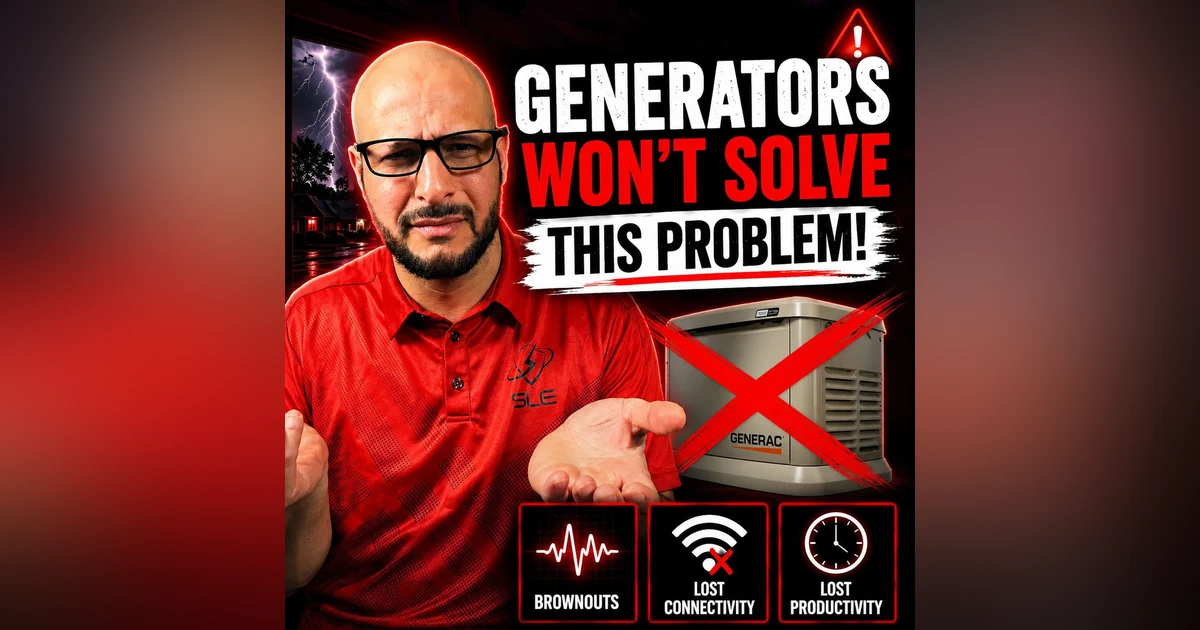

Want the exact six-option backup-power system I use to protect work-from-home clients? Grab the SLE App Pro below and steal the whole system: https://serviceloopelectrical.com/pro-app Watch the FULL Episode here: https://youtu.be/IZcEeNffARQ ———————————— Most electricians hear “power outage”… Recommend a generator. Ignore the five-second blips. Skip the brownouts. And quote one permanent system. Repeat until the customer's Zoom call flatlines while the generator collects dust. Mea...


Want the exact six-option backup-power system I use to protect work-from-home clients?
Grab the SLE App Pro below and steal the whole system:
https://serviceloopelectrical.com/pro-app
Watch the FULL Episode here:
https://youtu.be/IZcEeNffARQ
————————————
Most electricians hear “power outage”…
Recommend a generator.
Ignore the five-second blips.
Skip the brownouts.
And quote one permanent system.
Repeat until the customer's Zoom call flatlines while the generator collects dust.
Meanwhile…
I've built backup-power options for nearly every outage scenario.
And most winning offers follow almost the exact same structure.
Like a Russian nesting doll.
Same framework.
Different layer of protection.
Because great backup power doesn't feel like preparing for doomsday…
It feels like uninterrupted work and a comfortable home.
But behind the scenes?
The best systems are built more like suspenders plus a belt.
In this video, I break down the exact system I use to build backup options that:
- protect work and electronics during five-second power blips
- preserve Internet, lighting, heating, and essential circuits
- move with homeowners instead of trapping value in one house
- price every layer for profit
- give three buyer types a relevant way to say yes
Inside, I'll show you:
- the six-option framework behind portable backup power (basic → economy → bronze → silver → gold → platinum)
- how a service-change sump pump changed Joseph's view of essential circuits
- why “power outage equals generator” is often wrong
- how an automatic transfer switch catches a voltage drop before work disappears
- the layered safety net behind UPS, battery, ATS, and generator protection
- why pricing every connector and wire nut is mostly rubbish
- how to turn a temporary home into a portable power plan
- the simple-service-rate method for covering growth, overhead, and consumables
- why dignity of choice beats guessing what a homeowner can afford
Also…
There's Joseph fighting dyslexia before the options became alphabet soup.
There's the sump pump that overflowed within five minutes of pulling a meter.
There's a 96-degree New York day shaping the air-conditioning backup.
There's Hurricane Sandy leaving local homes without power for eight weeks.
And there's Joseph stumbling over “most robust” during the live build.
If you're new here, binge the channel.
If you sell backup-power systems, steal the framework.
If you want to scale to $1M+ with less chaos…
Watch the Million Dollar Plan below.
————————————
And if you want to see our Million Dollar Plan — how we help Electric Service Business Owners build $1M+ companies without becoming a slave to the truck, the phone, or the chaos…
Watch here:
- https://youtu.be/T8wHmb56FwE
————————————
Podcast Scholarship Draw!
Turn your support into real rewards.
Subscribe, leave a review, or follow us. each action = 1 entry.
Monthly: Open Circuit Lifetime Membership ($1,500 value)
Twice per year: Service Loop Electrical Packages ($5,000 value)
Submit your entry here!
https://go.serviceloopelectrical.com/mde-draw
SPEAKER_02
The quickest ways to keep your clients working from home, protecting their expensive gear, and keeping the family safe during power blips just got a lot easier. And it comes from combining flexible battery backup systems with a new automatic transfer switch that comes from nature's generator. It's gonna be an absolute game changer. The cool thing is that this particular product in this episode is gonna be so helpful for so many people because it allows us to fill a gap that generators themselves alone don't fix.
SPEAKER_00
Hello, hello, hello, and welcome to the Million Dollar Electrician Podcast, where we help home service pros like you supercharge your business and spark up those sales.
SPEAKER_01
I'm Joseph Lucanny, and together with my co-host Clay New Meyer, we're here to share the secrets of how electricians sell over a million dollars from a single service band.
SPEAKER_00
Now it's time for sales. It's time for scale. It's time to become a million-dollar electrician.
SPEAKER_02
Hello, my friend, and welcome back. Believe it or not, the gap between where you are and a million dollars a year in service revenue is not as big as you think. It's not a talent gap. It's not a market gap. It's a systems gap. And systems can be fixed. This is a million-dollar electrician, more to give. For electricians done playing small, who want to break through with less stress, more time with their family, and money left over to enjoy with the built. I'm beyond honored and pumped to be here with you. By the end of this episode, you'll know exactly how to present it, price it, and put it in front of every homeowner who's working from home on your schedule. So let's jump into it. So we have Lenny and Sam, who just moved into what they consider to be not the long-term home. They're going to be here for under five years at the most. And they both work from home. One works in the office downstairs, one works in the office upstairs, and as a result, they get to enjoy being home together, even though they never really cross paths. Now, they lose power, and that's the primary reason they're concerned. But they don't lose power in the regular way. Normally, when we hear lose power, I'm like, a generator. But that's not it. In this situation, they lose power in short on and off blips. And that's the big concern that we're dealing with here. Now, the concern that we have is that if they're both working from home and power goes on, off, on, off, on, off, what's that gonna do to all their equipment? What is that gonna do with their productivity? What is that gonna do for their peace of mind? So we found out their primary concern is brownouts. They consistently get under voltage and power goes on, off. And as a result, they're really concerned about the equipment in their office. Now, the thing is, is they're not also sold on this house. We mentioned they don't want to be here for more than five years. This could just be the transition house. The thing is, if you really dig into it deeper, it being a portable setup is actually gonna be really helpful for them. Because what they had said was that they understand there are like larger substantial things, like they can get a solar system and they can get um, you know, all the battery backups, like the whole nine yards, the permanent infrastructure, and they had gotten quotes for it already, but it was way beyond what they wanted to invest because they're not gonna be here. So why are they gonna put all that money into a system that's meant for long-term use in order to maximize the investment? Oh no, they're gonna leave in a few years, if that. So portability is gonna be an additional factor we got to get into here. Now, the panel's in good shape, no electronics protection, and the main panels in the garage where they ideally would be storing a generator or a battery. But here's the real issue. Lenny and Sam don't just need power, they need confidence that their work, their electronics, and their essential home systems are gonna be protected without feeling locked into a system they can't take with them. Now, I really got to make sure we understand why this is such a big deal. Normally, I love generators. I'm a generator junkie, I can't help myself. But generators wouldn't solve this problem. Because let's say they lose power and it's a five second on off. That means that they lose power, all their computers drop out, everything drops in the home, and before they can even get out of their chair, power comes back on. They sit back down in their chair, power goes off again. Multiple times throughout the day, or throughout the week, or throughout the month. It doesn't matter the frequency, it matters that it's happening enough that they're stressed that they constantly are dealing with this problem and they don't know how to do it without damaging everything. That's the problem we're gonna be getting into solving today. And I can't wait to walk you through the kind of solutions we're gonna be dealing with because this is gonna be a lot of fun. Now it comes time for the fun part. We actually get to build the options together. But before we do so, I want to make sure we understand the product that we're gonna be using to solve the problem and the problem we're trying to solve. So we talked about Lenny and Sam and the fact that they have these issues where they lose power on and off. Now, normally the concern is that when you have someone who has a power outage, we start leaning into generators. But the problem with this is that they lose power regularly, pretty regularly. But it's not always for long outages, it could just be on-offs, getting regular brownouts. And for people who work from home and have constant, you know, desktop monitors and lighting and screen setups and cameras, and it's a lot. There's a lot to be protecting, let alone everything else that's already in the home. So in this situation, we're gonna be leaning more towards a battery backup system that's portable that you can actually roll around and take with you when you move. Now, the product that I found that is just mind-blowing is it's from a company called Nature's Generator, where they finally created an ATS, meaning an automatic transfer system, that's meant to be used for non-automatic generators. You could actually connect it to a portable generator, or you can connect it to a battery backup. What happens is that it's constantly sensing for a certain level of voltage. And the moment that voltage drops, this kicks over to an instant battery backup. So the cool thing is that with this new nature's generator brand, we're able to now solve a problem that otherwise wasn't able to be solved with that much larger and more expensive infrastructure. If you want to see exactly how to structure those options, increase your ticket size without being pushy, and understand why homeowners really buy, go watch the full episode right now on YouTube. Links in the description. See you there.